Territory Planning Isn’t a Mapping Problem, It’s a Business Strategy
For many organizations, territory planning still happens much the same way it did a decade ago. Sales leaders divide geography into regions, assign accounts to representatives, review workload once or twice per year, and adjust boundaries only after major organizational changes.
That approach made sense when customer data changed slowly and market conditions remained relatively stable.
Today’s sales environment looks very different.
Customers change purchasing patterns more frequently. Construction projects move faster. Healthcare providers consolidate. Distribution networks shift. New competitors emerge within weeks rather than years. Buyers increasingly complete much of their research before agreeing to an in-person meeting.
Static territories quickly become outdated.
Territory planning is the continuous practice of allocating customer accounts and selling time across a field sales team based on data, not fixed geography.
The organizations consistently outperforming competitors increasingly treat territory planning as a living operational process rather than an annual spreadsheet exercise. Instead of asking, “How should we divide our map?” they ask, “How should our field organization allocate its limited selling time today?”
That shift fundamentally changes the role of field sales software.
Rather than functioning as a digital notebook or mapping application, modern platforms become decision-support systems that continuously help sellers prioritize the right accounts, travel efficiently, capture richer customer intelligence, and provide managers with visibility into what actually happens between customer visits.
Why Territory Planning Directly Impacts Revenue
Territories determine far more than driving distance.
They influence:
- Customer coverage
- Rep capacity
- Pipeline quality
- Forecast accuracy
- Customer experience
- Employee retention
- Sales productivity
When territories become unbalanced, the effects cascade throughout the organization.
One representative may inherit too many high-value accounts to visit regularly. Another may spend hours driving between low-potential customers. Managers struggle to understand whether underperformance reflects poor execution or poor territory design.
Leadership often responds by adding headcount.
Instead, leadership should ask whether existing selling capacity is being deployed effectively.
Research shows that organizations gain a competitive advantage when they use data to treat operational decisions, including resource allocation, as continuous optimization problems rather than periodic planning exercises. Organizations that systematically use operational data make faster and more effective business decisions because information becomes part of daily execution rather than retrospective reporting.
Territory planning is one of the clearest examples of this principle in field sales.
Stop Optimizing Miles. Start Optimizing Selling Time.
Traditional routing software focused on one objective: minimize drive time.
While reducing windshield time remains valuable, it is no longer sufficient.
The real objective is maximizing productive customer engagement.
Imagine two routes.
- Route A saves forty-five minutes of driving.
- Route B requires twenty additional minutes behind the wheel but enables meetings with three strategic accounts approaching renewal.
Which creates greater business value?
The answer depends entirely on customer context.
Modern route optimization considers far more variables than physical distance:
- Customer lifetime value
- Revenue opportunity
- Buying stage
- Service commitments
- Visit frequency
- Historical engagement
- Travel conditions
- Appointment windows
- Rep schedules
- Account priority
Instead of asking, “What’s the shortest route?” sales leaders increasingly ask, “What’s the highest-value day this representative could have?”
That represents a fundamentally different optimization problem.
Modern Territory Planning Begins with Customer Data, Not Geography
Many organizations still assign territories based primarily on:
- ZIP codes
- Counties
- States
- Legacy districts
- Historical ownership
Those boundaries rarely reflect actual market opportunity.
Instead, leading organizations evaluate multiple dimensions simultaneously.
Customer Concentration
- Where are high-value customers clustered?
- Where are underserved regions emerging?
- Where are competitors gaining traction?
Revenue Potential
Historical revenue tells only part of the story. Modern planning also considers:
- Growth rate
- Expansion potential
- Cross-sell opportunities
- Market penetration
- New account density
Service Requirements
Some industries require frequent in-person interaction. Others can support hybrid engagement models.
Pharmaceutical sales, medical device manufacturers, industrial distributors, and construction suppliers often require different visit frequencies despite operating in similar geographic regions.
A territory containing fewer accounts may actually require substantially greater selling effort.
Travel Complexity
Two territories covering identical square mileage can require dramatically different driving time depending on:
- Traffic patterns
- Customer clustering
- Urban density
- Rural travel
- Appointment availability
This is where geospatial CRM platforms distinguish themselves from traditional CRM systems. Rather than viewing customer records as rows inside a database, they visualize relationships across geography, allowing organizations to understand how time, distance, opportunity, and customer value intersect.
Why a Field-Ready CRM Execution Layer Is Key to Better Customer Data
Territories can only become more logical and efficient when organizations trust their underlying data. Unfortunately, CRM quality often deteriorates precisely because field sellers spend their days away from desks. After multiple customer visits, representatives return to the office with handwritten notes, business cards, and follow-up tasks.
Updating customer records becomes evening work.
… Or Friday work.
… Or next week’s work.
Eventually it becomes incomplete work.
Incomplete customer data creates a chain reaction:
- Managers lose visibility.
- Forecasts become less reliable.
- Route planning relies on outdated information.
- Territory reviews become subjective discussions rather than evidence-based decisions.
The solution isn’t asking representatives to perform more administrative work. It’s reducing the amount of administrative work required.
Modern mobile-first field sales platforms allow representatives to capture customer interactions immediately after meetings through streamlined workflows, automated activity logging, voice notes, and mobile updates.
The result isn’t simply cleaner CRM records. It is higher-quality operational intelligence.
According to Salesforce research, sales representatives spend only about 22% of their working time actively meeting with customers and another 20% of their time prospecting. That leaves the majority consumed by administration, research, meetings, and other non-selling activities. Reducing manual documentation creates more capacity for customer engagement while improving data quality simultaneously.
Insight: Map My Customers’ own third-party research found that how field reps work often results in bigger performance gaps than the makeup of their territory alone. In other words, reps who work smarter, not just harder, by planning their days and using digital tools to be more efficient tend to see better outcomes.
From Activity Tracking to Behavioral Intelligence
Many CRM implementations answer one question: “Did the representative log activity?”
Modern field sales organizations seek answers to a much more valuable question: “What behaviors consistently produce successful outcomes?”
This distinction matters enormously.
High-performing organizations increasingly analyze patterns such as:
- Visit cadence
- Account sequencing
- Time between follow-ups
- Geographic clustering
- Customer engagement frequency
- Route consistency
- Opportunity progression
Instead of measuring activity volume alone, managers begin identifying repeatable behaviors shared by top performers.
For example:
- A leading representative may consistently visit distributors before contractors.
- Another schedules follow-up meetings within 48 hours of initial visits.
- Another clusters customer visits around seasonal purchasing cycles.
Without reliable mobile data capture, these insights remain invisible. When sales leaders can capture this information, these actions can become organizational best practices that managers can coach across the broader sales force.
Turn Territory Reviews into a Continuous Optimization Process
Many enterprise sales organizations still evaluate territories only when something forces a change: a rep leaves, a region misses quota, an acquisition expands the customer base, or leadership launches an annual planning cycle.
That cadence is increasingly out of step with how markets evolve.
Customer demand shifts throughout the year. New construction projects break ground. Health systems merge. Distributor relationships change. Economic conditions alter purchasing priorities across regions. If territory design remains static while the market changes, even highly capable sales teams gradually lose efficiency.
Instead of treating territory planning as a once-a-year exercise, leading organizations establish a regular review process that combines CRM activity, geographic intelligence, and business performance data.
Rather than asking, “Which territories need to be redrawn?” managers should ask questions such as:
- Which accounts haven’t received an in-person visit within their target cadence?
- Which reps consistently spend more time driving than selling?
- Where are high-growth accounts concentrated?
- Which territories have become overloaded as customer bases expanded?
- Where are new opportunities emerging that don’t align with current territory boundaries?
This approach transforms territory planning from reactive administration into proactive sales strategy.
Connect Route Planning to Account Prioritization
The most productive route isn’t necessarily the shortest one. It’s the route that gives a representative the greatest opportunity to create customer value during the available selling time.
That requires integrating routing decisions with account strategy. Instead of generating routes solely from appointment locations, modern field sales organizations prioritize visits based on business objectives, including:
Strategic Accounts. Customers with significant expansion potential or executive relationships may warrant more frequent visits, even if travel time increases.
Buying Signals. Accounts showing renewed purchasing activity, organizational change, new projects, or recent engagement may deserve immediate attention. (Learn more about how field sales software can help your organization better monitor and understand buying signals and customer intent.)
Service Commitments. Existing customers often expect consistent visit schedules. Route planning should protect these commitments while balancing new business development.
Territory Coverage. Some accounts may not require monthly visits, but they shouldn’t disappear from the sales calendar.
Modern field sales software helps managers balance these competing priorities by combining mapping, customer intelligence, and scheduling into a single planning workflow.
Give Managers Visibility into Execution, Not Just Results
Pipeline reports explain outcomes. They rarely explain how those outcomes occurred.
That distinction matters because coaching field sales reps requires understanding execution, not simply measuring revenue.
Modern field sales platforms enable managers to answer questions such as:
- Are field reps spending adequate time with high-value customers?
- Which territories receive the most consistent coverage?
- How often do opportunities stall after initial meetings?
- Which customer segments generate the highest return from in-person engagement?
- Are reps following recommended visit cadences?
Instead of relying exclusively on quarterly performance reviews, managers can identify coaching opportunities in real time, while they can still influence future results.
This shift also creates a more objective coaching process. Rather than asking why a rep missed quota, managers can examine observable behaviors, including coverage frequency, travel patterns, follow-up consistency, and account prioritization, to identify practical improvements.
Reduce Administrative Work Without Sacrificing Data Quality
One of the biggest misconceptions surrounding CRM adoption is that better data requires more data entry.
In practice, the opposite is often true. The easier it is for representatives to capture information in the moment, the more complete and accurate that information becomes.
Effective field sales software reduces administrative effort through capabilities such as:
- Automatic activity logging
- Mobile note capture immediately after customer visits
- GPS-assisted visit confirmation
- Calendar integration
- Contact synchronization
- Voice-to-text meeting summaries
- Automated follow-up reminders
The goal is to preserve customer intelligence while it’s still fresh. Every hour between a customer meeting and CRM documentation increases the likelihood that important details are forgotten, remembered incorrectly, or never recorded.
Use Geographic Intelligence to Improve Sales Leadership Decisions
Maps have always been useful for visualizing customer locations. Today’s geospatial CRM platforms extend that value much further. They help leadership understand relationships between geography, customer behavior, and the bottom line.
For example, sales leaders can identify:
- Territories with unusually high travel demands.
- Regions producing strong revenue despite relatively few visits.
- Underserved markets with growing customer density.
- Clusters of inactive accounts.
- Areas where account ownership should be reassigned.
- Emerging geographic opportunities based on customer expansion.
Instead of evaluating territories through static tables, leaders can see how customer concentration, travel efficiency, account coverage, and sales outcomes interact across the market. This type of visibility supports decisions that would be difficult to make from spreadsheets or traditional CRM reports alone.
Look for platforms that can be customized for your sales team’s specific needs, so your organization is building around its data, not a template. Ask about:
- Bespoke visualizations built to help you understand your company’s KPIs.
- Scoring for account activity and engagement so you can make comparisons and identify gaps.
- Custom prompting to tailor analysis to your company’s actual priorities.
- Automatic surfacing of opportunities, risks, and key themes for further exploration.
- Insights into where reps need coaching, along with specific examples from your data.
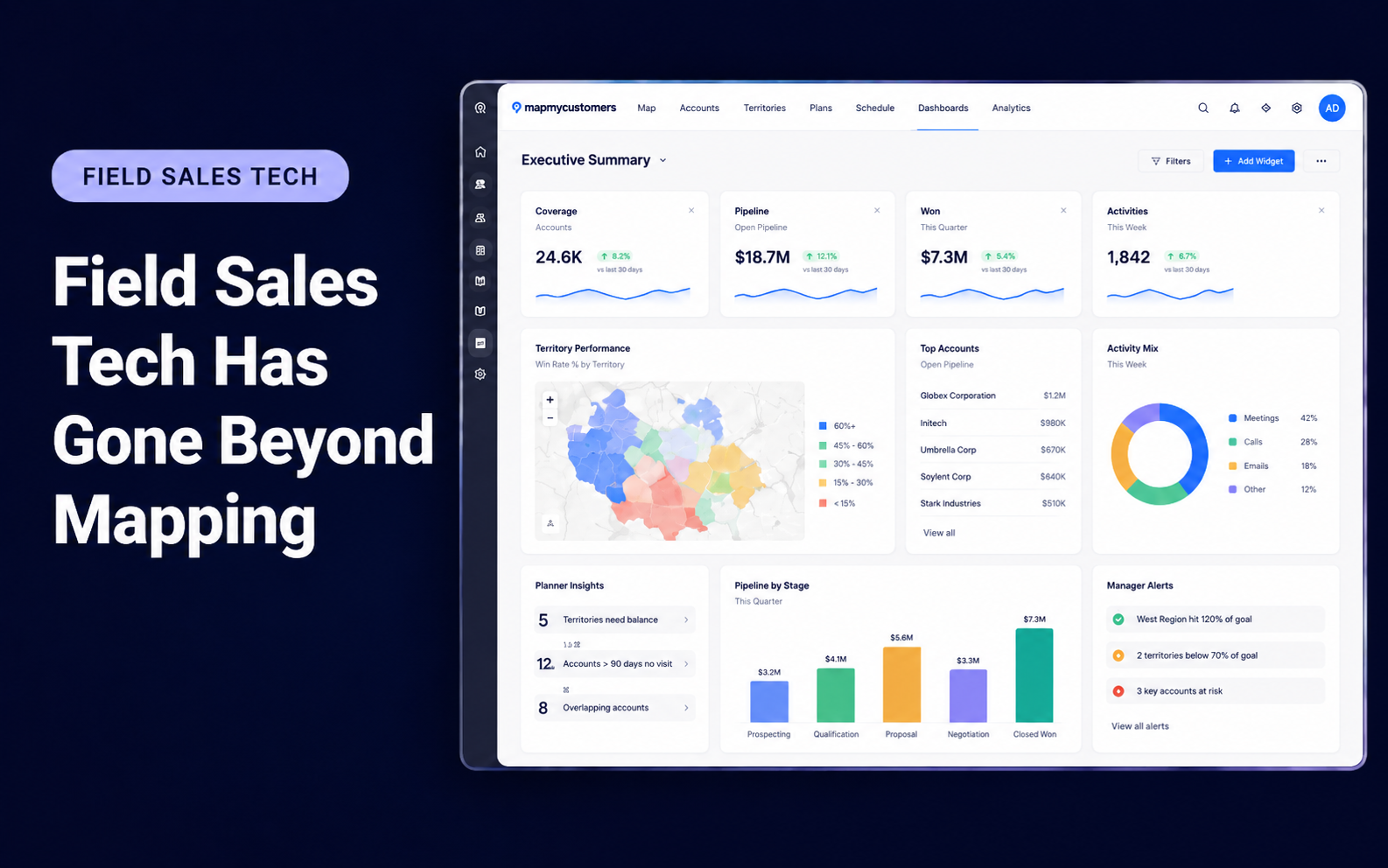
Your dashboards should be able to tell you: what happened in the field today.
What Enterprise Buyers Should Look for in Field Sales Execution Software
Many organizations begin evaluating field sales software by comparing feature checklists. A more effective approach is evaluating how well a platform supports your organization’s day-to-day execution needs.
Key capabilities to look for include:
| Capability | What to Look For |
|---|---|
| Mobile-First Design | Reps can access and update customer information from the field without returning to the office or waiting until the end of the day. |
| Integrated Territory Planning | Territory management combines customer data, geography, workload, and opportunity, not just account locations on a map. |
| Intelligent Route Optimization | Routing prioritizes business objectives alongside travel efficiency. |
| Automatic Activity Capture | Reduced manual documentation improves both adoption and data quality. |
| Manager Visibility | Supervisors can understand territory coverage, customer engagement, and execution patterns without relying on anecdotal updates. |
| CRM Integration | Field sales platforms complement, not replace, the organization’s broader CRM and business systems, with customer data flowing consistently between applications. |
The Role of AI and the Future of Field Sales
Artificial intelligence is becoming increasingly important across enterprise sales organizations, but AI is only as effective as the data supporting it.
Organizations hoping to use AI for forecasting, opportunity scoring, territory recommendations, or sales coaching need complete, timely, and consistent field activity data.
If customer interactions remain undocumented, delayed, or fragmented across disconnected systems, AI models inherit those gaps.
Conversely, organizations that capture structured field activity through mobile-first workflows create a stronger foundation for advanced analytics and future AI capabilities.
Improving territory planning today prepares organizations for the next generation of sales intelligence.
5 Best Practices for Better Territory Planning and Route Optimization
- Review territories continuously rather than annually. Incorporate customer growth, account coverage, travel time, and market changes into ongoing territory management.
- Prioritize selling time instead of minimizing driving time. Optimize routes based on customer value, buying stage, and strategic importance, not just mileage.
- Capture customer information immediately after every visit. Mobile-first workflows improve CRM accuracy, reduce administrative burden, and preserve valuable customer context.
- Coach behaviors, not just outcomes. Use activity patterns, visit cadence, follow-up timing, and territory coverage to identify repeatable best practices from top performers.
- Integrate geographic intelligence into sales planning. Combine maps, CRM data, customer priorities, and operational analytics to make territory and routing decisions based on business impact rather than geography alone.
Territory Planning Is Your Latest Competitive Advantage
Territory planning has evolved beyond drawing geographic boundaries and minimizing driving time.
For enterprise field sales organizations, it has become an operational discipline that directly influences productivity, customer experience, coaching effectiveness, and long-term growth.
The organizations gaining an advantage aren’t simply asking representatives to work harder. They’re giving those representatives better information, better priorities, and better tools so they can work smarter.
Modern field sales software helps organizations connect customer intelligence, territory design, route optimization, and execution into a single operating model. Representatives spend less time on administration and more time with customers. Managers gain visibility into the behaviors that drive success. Leadership can continuously refine territories as markets evolve rather than relying on annual planning cycles.
For organizations where field selling remains central to revenue generation, investing in smarter territory planning isn’t just an operational improvement. It’s a strategic capability that enables more consistent execution, better customer coverage, and a scalable foundation for data-driven decision-making.
Ready to turn your territory data into revenue? Book a demo to see how Map My Customers helps field sales teams plan smarter, execute faster, and coach with confidence.