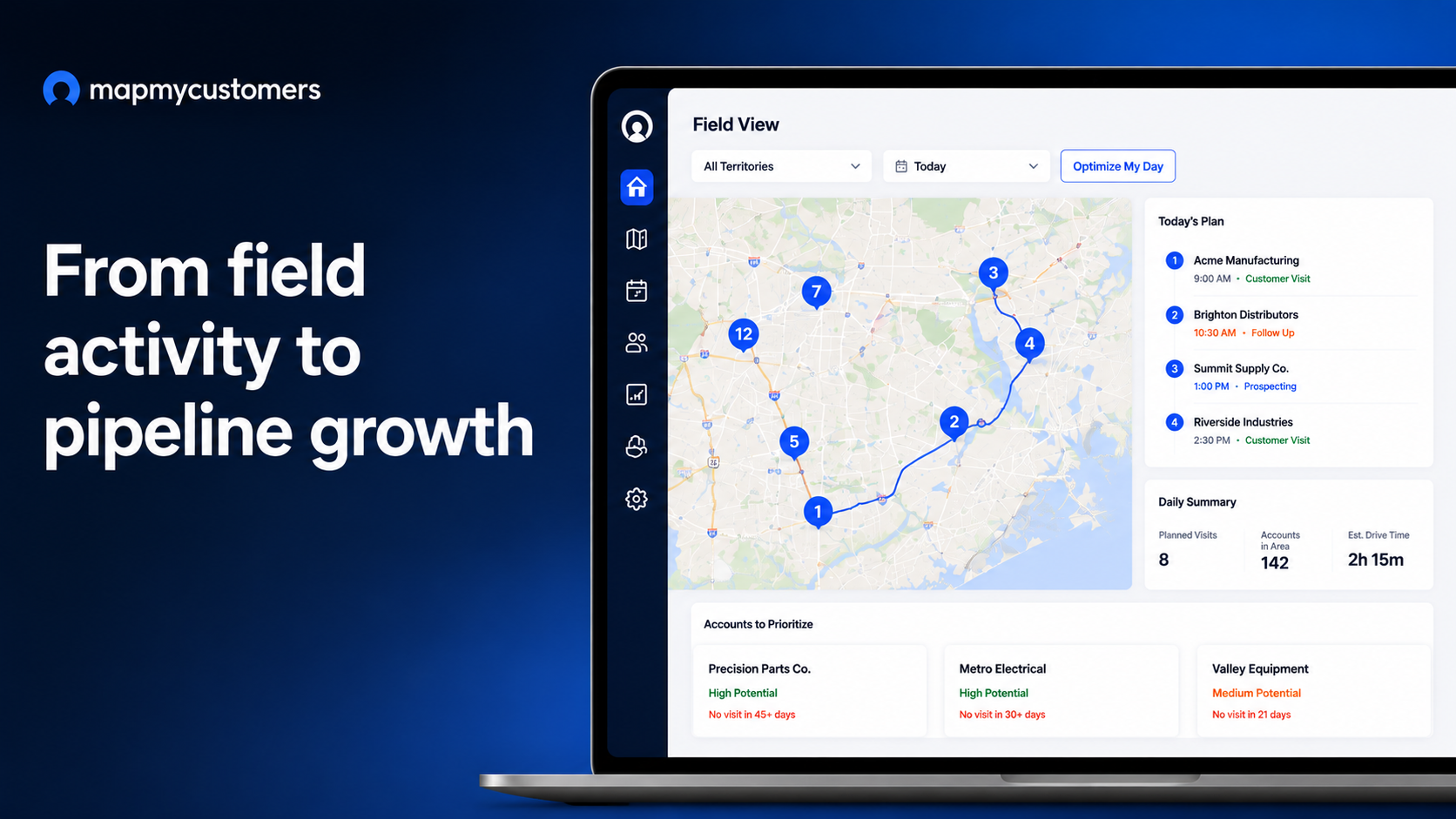
From Field Activity to Pipeline Growth: How Modern Field Sales Software Improves Top-of-Funnel Performance
Field sales teams don’t have a shortage of activity. They have accounts to visit, prospects to follow up with, territories to cover, relationships to maintain, and opportunities to uncover.
The challenge is making sure all of that activity actually creates pipeline.
Field sales representatives also spend a significant amount of time planning their days, researching accounts, updating customer records, logging activity, and figuring out where to go next. For sales organizations trying to increase top-of-funnel volume, every unnecessary administrative task takes time away from prospecting and customer engagement.
Top-of-funnel volume is the amount of new pipeline activity, prospecting, account engagement, and opportunity creation feeding a sales team’s pipeline.
Modern field sales software is designed to close that gap. It connects territory planning, account prioritization, customer engagement, activity capture, and manager visibility so field teams can spend more time selling and sales leaders can better understand which activities are driving results.
In this guide, we’ll look at how field sales software can improve seller productivity, strengthen territory execution, reduce administrative work, help managers coach more effectively, and turn successful field behaviors into a repeatable methodology for pipeline growth.
Key Takeaways
Field sales software helps organizations improve the work that happens before an opportunity enters the pipeline, where decisions about prospecting, territory coverage, account prioritization, and customer engagement can determine future revenue.
The right field sales platform can help teams:
- Reduce seller admin time so field reps can spend more time on revenue-generating activities.
- Drive more top-of-funnel volume through better territory planning, account prioritization, and field execution.
- Improve sales productivity by making customer data easier to capture, access, and act on.
- Strengthen sales methodology by identifying repeatable behaviors from successful sellers.
- Give managers and sales leaders clearer visibility into field activity and customer engagement.
- Create a more connected workflow between sellers, managers, sales operations, and the CRM.
The Productivity Challenge: Field Sales Teams Need More Selling Time, Not More Reporting Tasks
Field sales representatives have always balanced two competing responsibilities: spending time with customers and maintaining accurate business records.
As sales organizations become more data-driven, that balance gets harder. Companies need better customer information, but collecting it can create additional work for the people responsible for generating revenue.
Consider what happens after a typical customer visit.
The rep may need to update the CRM, add notes, log the activity, schedule a follow-up, research the next account, determine which customers are nearby, and then get back on the road.
Multiply that across every customer interaction, every rep, and every territory.
If capturing information feels separate from selling, something eventually gives. Updates get delayed. Notes become incomplete. Valuable information stays in the rep’s head. And time that could have been spent with another customer gets consumed by administrative work.
For field sales teams, successful technology adoption depends on removing that friction.
If entering information requires sellers to:
- Return to a desk after customer visits
- Manually update multiple systems
- Recreate information already captured elsewhere
- Complete administrative steps unrelated to selling
- Spend significant time preparing reports about work they’ve already done
then data quality and sales productivity can both suffer.
The better question isn’t, “How do we get reps to complete more reporting?”
It’s: how do we make accurate sales data a natural outcome of selling?
That’s one of the fundamental problems modern field sales software is designed to solve.
How Field Sales Software Reduces Seller Admin Time
Field reps don’t work from a desk. Their technology shouldn’t assume they do.
Their work happens in customer locations, between meetings, while traveling through territories, during conversations with prospects, and immediately after customer interactions.
Field sales software brings the tools and information reps need into those workflows instead of requiring them to adapt their day to systems designed for office-based sellers.
Mobile-First Customer Intelligence
Before walking into an account, a rep should be able to quickly understand what’s happening with that customer.
Modern field sales platforms can give representatives access to information such as:
- Account history
- Previous interactions
- Customer notes
- Territory information
- Upcoming opportunities
- Recent activity
- Relevant contacts
Having that context readily available reduces the time reps spend searching for information before meetings and helps them walk into customer conversations better prepared.
Easier Activity Capture
The work doesn’t stop when the meeting ends.
Reps need a simple way to capture what happened while the conversation is still fresh. When activity logging fits naturally into the field workflow, organizations can reduce reliance on reps reconstructing their day hours later.
Simpler activity capture can help reduce:
- Incomplete CRM records
- Delayed reporting
- Inconsistent activity tracking
- Lost customer context
- Information trapped in individual reps’ notes or memory
Simpler Field Workflows
The best field sales tools are designed around how sellers actually work.
That means reducing unnecessary clicks, duplicate data entry, disconnected applications, and administrative steps so representatives can focus more of their energy on customer engagement.
The business impact is straightforward. More time selling creates more opportunities to engage prospects. More prospect engagement creates more opportunities to build pipeline.
Improving Territory Execution: Turning Field Activity Into More Opportunities
Giving reps more time is only useful if they’re spending it in the right places.
More activity does not automatically create more pipeline.
A representative can spend an entire day visiting accounts and still miss the highest-value opportunities if territory strategy and account priorities aren’t clear.
That’s why field sales productivity isn’t simply about maximizing the number of visits a rep makes. It’s about helping reps make better decisions about where to go, who to see, and what to do next.
Field sales software helps organizations improve the quality of activity by adding context around where and how sellers spend their time.
Use Territory Intelligence to Focus Seller Effort
Field sales teams often manage complex markets that include:
- Large geographic regions
- Hundreds or thousands of potential accounts
- Different customer values
- Different buying cycles
- Uneven opportunity density
- Changing market conditions
Without accurate territory visibility, sellers can easily fall into familiar patterns.
They visit the customers they know. They take the routes they’re comfortable with. They spend time with accounts that are easy to reach rather than those with the greatest potential.
Meanwhile, high-value accounts can receive too little attention and whitespace within the territory can go unnoticed.
Modern field sales platforms can help teams analyze:
- Account distribution
- Geographic coverage
- Customer density
- Opportunity concentration
- Gaps in market coverage
- Rep activity across a territory
That gives sellers and leaders a better way to answer questions like:
- Are reps spending time in the right places?
- Are high-potential accounts receiving enough attention?
- Which accounts haven’t been engaged recently?
- Are territories balanced appropriately?
- Where are additional prospecting opportunities located?
- Where should a rep spend the next hour of their day?
Better territory decisions create better use of limited selling capacity. For a deeper look at how leading teams approach this, see how high-performing field sales teams turn territory data into revenue.
How Field Sales Software Helps Managers Improve Coaching and Execution
Most sales reporting tells managers what already happened.
Revenue generated. Opportunities created. Pipeline produced. Quota attainment.
Those metrics matter, but they’re lagging indicators. By the time they reveal a problem, the behavior that created that problem may have been happening for weeks or months.
Managers need visibility into the activities that create those outcomes.
Field sales software can help leaders understand:
- Account coverage patterns
- Rep activity levels
- Territory engagement
- Follow-up consistency
- Customer interaction trends
- Changes in field behavior
That creates an opportunity for a much more proactive coaching model.
Instead of discovering at the end of the month that a territory isn’t producing enough pipeline, a manager can see whether important accounts aren’t receiving attention, coverage has declined, follow-up is inconsistent, or a rep’s activity patterns have changed.
Instead of asking, “Why did this territory miss target?” managers can ask, “What execution patterns are preventing this territory from creating enough opportunities?”
That distinction matters because one question explains a past result. The other gives the manager an opportunity to influence what happens next.
How Field Sales Software Helps Leaders Identify and Replicate Top-Performer Behaviors
Every sales organization has representatives who seem to know where to spend their time.
They prioritize the right accounts. They manage their territories effectively. They build relationships. They follow up consistently. They find opportunities others miss.
Most organizations know who their top performers are. The harder question is why they’re outperforming everyone else.
Are they:
- Visiting customers more frequently?
- Focusing on specific account segments?
- Prioritizing certain customer profiles?
- Following up more consistently?
- Managing their territories differently?
- Creating more early-stage customer engagement?
- Covering more of their available market?
Without visibility into field activity, the answers are often based on observation and intuition rather than measurable patterns.
Field sales software gives organizations another layer of information. Revenue metrics show what happened. Field activity data can help explain why it happened.
Two representatives may achieve similar results through very different approaches. One might focus on a smaller group of high-value accounts and build relationships through frequent engagement. Another might generate success through broader territory coverage and higher prospecting volume.
Understanding those patterns gives leaders a better foundation for determining which behaviors are worth replicating across the organization and where different strategies may be appropriate.
The goal isn’t to turn every salesperson into the same salesperson. It’s to identify the behaviors worth repeating and give the rest of the team a better opportunity to learn from them.
Building a More Consistent Sales Methodology With Field Data
Many field sales organizations still rely heavily on informal knowledge transfer.
A new representative learns through:
- Ride-alongs with experienced sellers
- Manager coaching
- Individual conversations
- Tribal knowledge
- Trial and error
Those approaches remain valuable. But when they’re the primary way knowledge moves through an organization, execution becomes highly dependent on individual experience.
A scalable sales methodology requires more than documenting what sellers should do. It requires understanding what actions consistently contribute to pipeline creation.
Field sales software can help organizations make that connection by providing insight into:
- Where sellers are spending their time
- How frequently accounts are being engaged
- Which activities tend to precede opportunity creation
- How territories are being managed
- What customer engagement patterns indicate increased interest
- How successful sellers prioritize their available time
Those insights give sales leaders another source of evidence when refining coaching, onboarding, territory strategy, and sales methodology.
Field data doesn’t replace manager experience or judgment. It gives managers better information to apply that judgment.
How Field Sales Software Helps Drive More Top-of-Funnel Volume
Pipeline growth is ultimately influenced by sales activity, but effective pipeline generation depends on more than increasing activity volume.
Organizations need the right activity, directed toward the right accounts, executed consistently.
Field sales software helps improve several of the upstream processes that influence pipeline creation.
Better account targeting. Sales teams can identify where opportunity exists by combining customer information, territory data, and field intelligence. That can help representatives spend less time searching for potential opportunities and more time engaging accounts that fit their priorities and ideal customer profile.
More consistent prospect engagement. Opportunities can be lost simply because follow-up is inconsistent or account activity is difficult to track. Field sales technology can help teams maintain visibility into customer interactions and identify accounts that haven’t received the attention they should.
Stronger territory coverage. Most field teams have more potential accounts than they can effectively manage. Technology can help sales leaders understand where coverage is strong, where it is weak, and where additional attention may be warranted.
Faster learning cycles. When organizations can see which activities are producing results, they don’t have to wait until the end of a quarter to determine whether a strategy is working. They can learn from what’s happening in the field and adjust more quickly.
The objective isn’t simply to create more field activity. It’s to increase the amount of field activity that has a meaningful chance of producing revenue.
Overcoming Common Barriers to Field Sales Technology Adoption
Field sales software can only improve pipeline generation if teams actually use it.
That sounds obvious, but adoption is particularly important in the field, where technology competes with customer meetings, travel, changing schedules, and the realities of a rep’s day.
If a new platform primarily creates value for management while asking representatives to do more work, adoption will always be an uphill battle.
The strongest field sales platforms provide immediate value to the seller. They should:
- Simplify data capture
- Reduce duplicate entry
- Integrate with existing workflows
- Make customer information easier to access
- Help reps prepare for customer interactions
- Help sellers prioritize their time
- Make daily planning easier
The goal is not to create another reporting obligation. The goal is to make selling easier.
Align Technology Adoption With Sales Methodology
Technology alone doesn’t improve sales productivity.
Organizations first need to understand what successful field execution looks like for their business.
Before implementing field sales technology, leaders should be able to answer questions such as:
- Which activities are most likely to create pipeline?
- Which customer signals matter most?
- How should territories be managed?
- How frequently should different types of accounts be engaged?
- What information do managers need to coach effectively?
- What should a rep know before walking into a customer meeting?
Technology can then reinforce those processes. Field sales software works best when it supports a clear sales methodology rather than attempting to replace one.
How to Evaluate Field Sales Software for Top-of-Funnel Growth
Choosing field sales software shouldn’t be viewed as a technology decision alone. It’s a decision about how effectively an organization can create, manage, and scale top-of-funnel activity.
The right platform should help answer a fundamental question: does this technology make it easier for sellers to identify opportunities, engage the right accounts, and execute the behaviors that consistently create pipeline?
When evaluating field sales software, sales leaders should look beyond individual features and consider whether the platform improves three factors that drive pipeline growth: seller productivity, manager visibility, and repeatable sales execution.
1. Does the Platform Give Sellers More Time to Create Opportunities?
The best field sales technology reduces the administrative burden that takes sellers away from prospecting and customer engagement.
Evaluate whether the platform helps representatives:
- Quickly access customer and account information in the field
- Capture activity without extensive manual entry
- Spend more time engaging prospects and customers
- Prioritize the accounts most likely to create opportunities
- Plan their days and territories efficiently
A field sales platform should increase selling capacity, not create another system sellers have to maintain.
2. Does the Platform Help Managers Improve the Activities That Create Pipeline?
Pipeline results are a lagging indicator.
Managers need visibility into the field behaviors that influence those results while they still have an opportunity to change them.
Consider whether the software enables leaders to understand:
- Where field reps are spending their time
- Whether territories are receiving appropriate coverage
- Which activities are associated with opportunity creation
- Which accounts may be receiving too little attention
- Where coaching can improve execution
Better visibility helps managers move from reacting to missed targets to improving the behaviors that drive future pipeline.
3. Does the Platform Help Leadership Build a More Repeatable Sales Methodology?
Top-performing sellers often develop effective approaches through years of experience. The organization needs a way to learn from those behaviors and scale what works.
Look for technology that can help identify:
- How successful sellers prioritize accounts
- What engagement patterns lead to opportunities
- Which territory strategies produce results
- How frequently different types of customers are engaged
- What behaviors should become part of the broader sales process
The goal isn’t simply to measure field activity. It’s to understand which activities create pipeline and build a more consistent approach to generating opportunities across the organization.
5 Best Practices for Using Field Sales Software to Grow Top-of-Funnel Pipeline
Generating more top-of-funnel volume isn’t simply about increasing the number of activities sellers complete. The strongest field sales organizations create more opportunities by improving the quality, consistency, and scalability of the activities that lead to pipeline creation.
Here are five ways sales leaders can get more value from field sales technology.
- Identify the field activities that consistently create pipeline. Not every sales activity contributes equally to opportunity creation. High-performing organizations look for the behaviors most closely associated with pipeline growth, including visit frequency, account coverage patterns, follow-up timing, engagement with specific account segments, and territory activity levels. Understanding which activities drive results allows leaders to focus teams on behaviors that create meaningful pipeline instead of simply measuring activity volume.
- Reduce administrative friction so sellers can spend more time prospecting. One of the clearest ways to create more selling capacity is to reduce the amount of time representatives spend on work that doesn’t require their selling skills. Field sales software can simplify customer data capture, activity logging, territory management, account research, field reporting, and daily planning. When sellers spend less time maintaining disconnected systems, they have more capacity to identify prospects, engage accounts, and create new opportunities.
- Use territory intelligence to improve account coverage and prioritization. Pipeline growth depends on reaching the right accounts at the right time. Field sales technology can help organizations identify high-potential accounts, uncover gaps in territory coverage, balance seller workloads, prioritize customer visits, and improve market penetration. Setting SMART sales goals around these metrics gives reps clear targets and managers a framework for coaching.
- Give managers visibility into field execution so they can improve performance. Sales managers can’t improve what they can’t see. Without accurate field data, coaching can depend too heavily on lagging results, rep self-reporting, or incomplete CRM information. Field sales software gives managers greater visibility into how territories are being worked, which accounts are receiving attention, where prospecting activity is increasing or declining, how consistently customers are being engaged, and which behaviors separate high-performing sellers.
- Turn top-performer behaviors into a repeatable sales methodology. Many organizations know who their best sellers are but struggle to understand exactly why they’re successful. Field sales software can help leadership identify patterns behind strong performance, including how top sellers prioritize accounts, manage territories, engage prospects, and balance prospecting with relationship building. Those insights can inform onboarding, coaching programs, territory strategies, and sales processes.
Field Sales Software Creates a Foundation for More Predictable Pipeline Growth
For field sales organizations, increasing top-of-funnel volume isn’t simply a matter of asking representatives to make more calls, complete more visits, or work harder.
Sustainable growth requires improving the systems and processes that determine how sellers spend their time, how territories are covered, how managers coach performance, and how organizations learn from what’s working.
Modern field sales software helps create that foundation by reducing administrative work, improving visibility into field execution, strengthening territory management, and revealing the behaviors that drive results.
When customer data, territory intelligence, and sales activity are connected within the rep’s daily workflow, organizations gain the ability to improve not only individual productivity but also the broader sales methodology responsible for generating pipeline. Map My Customers was built to bring these capabilities together in one platform.
For reps, that means less time managing the work and more time selling. For managers, it means seeing execution early enough to influence it. For sales organizations, it means learning from what’s actually happening in the field and turning those insights into a more consistent way of working.
The result is a field sales organization that can execute more consistently, learn more quickly, and create stronger opportunities over time.
Ready to connect field activity to pipeline growth? Book a demo to see how Map My Customers helps teams reduce admin time, improve territory execution, and build a repeatable path from field activity to revenue.