How Your Field Sales Team Can See Buyer Signals Sooner
B2B buying decisions don’t happen in a single moment. They develop through a series of interactions: a conversation with a sales representative, a competitor comparison, a request for technical information, a question about pricing, or a shift in operational priorities.
For field sales organizations, many of those signals appear during in-person interactions long before they become visible in traditional reporting systems.
A contractor mentioning that they are evaluating alternative materials. A healthcare provider asking how a device compares with another manufacturer. A distributor changing shelf placement priorities. A procurement team asking about implementation timelines.
These are not simple notes. They are indicators of buyer intent.
Buyer intent is the set of signals a customer reveals about where they are in a purchasing decision, whether through digital activity or, just as often for field teams, through in-person conversation.
The challenge is that many organizations still rely on systems designed primarily to store account information, not to capture the context surrounding customer decisions.
Customer relationship management (CRM) platforms remain essential for managing opportunities and account histories. But for field sales teams, the quality of CRM insights depends entirely on the quality and consistency of information entering the system.
When reps spend hours after customer visits manually entering notes, updating records, and reconstructing their day, if they get around to doing it at all, critical details get lost.
The result is a familiar problem: sales leaders have plenty of data but limited visibility into what customers are actually considering.
Buyer Intent Is Changing: Companies Need More Than Digital Signals
Many organizations think about buyer intent through the lens of digital activity: website visits, content downloads, search behavior, and engagement with marketing campaigns.
Those signals are valuable. But they represent only one part of the buyer journey.
For field sales organizations, some of the most important buying signals reach reps offline. A customer may never download a competitor comparison guide or fill out a form indicating interest. Instead, they may ask a sales representative:
- “How does your product compare with the other option we’re evaluating?”
- “Can you help us understand installation requirements?”
- “What are other companies in our industry choosing?”
- “How quickly can we transition if we switch suppliers?”
These questions reveal where a buyer is in their decision process.
Research from McKinsey on B2B purchasing behavior shows that buyers increasingly move between multiple channels throughout their journey, expecting companies to provide consistent and informed interactions across touchpoints.
B2B buyers use 10 channels, on average, across their purchasing journey and expect to move seamlessly among them. — McKinsey, 2026
For field sales teams, this means the customer visit is no longer just a relationship-building activity. It is a source of market intelligence.
The organizations that capture and analyze those interactions gain a clearer understanding of which:
- Competitors are appearing most frequently in customer conversations.
- Objections are preventing deals from moving forward.
- Customer needs are emerging across territories.
- Sales approaches are consistently producing results.
Digital Signals vs. Field Signals
| Digital Buyer Signals | Field Buyer Signals | |
|---|---|---|
| Where they show up | Website visits, content downloads, search behavior | In-person conversations, on-site observations |
| How they’re captured | Marketing automation, analytics platforms | Rep notes, voice memos, mobile CRM entries |
| What they reveal | Topical interest, campaign engagement | Specific decision criteria, named competitors, switching concerns |
| Risk if uncaptured | Lower, still logged in analytics tools | High, the signal disappears once the rep forgets or moves on |
The Problem With Traditional Field Sales Data Collection
Most field sales organizations do not struggle because they lack information. They struggle because information is fragmented.
A typical field seller may manage customer information across:
- CRM platforms
- Mobile notes
- Spreadsheets
- Calendar systems
- Territory maps
- Personal tracking methods
This creates several challenges.
1. Customer intelligence stays with individual sellers
Experienced sales representatives often develop deep knowledge of their territories. They know:
- Which customers are expanding.
- Which accounts are considering competitors.
- Which decision-makers influence purchases.
- Which objections appear repeatedly.
But if that information is not captured consistently, it leaves with the seller. The organization loses years of relationship intelligence every time employees change roles or territories.
Field sales software helps solve this problem by creating a structured way to capture customer interactions, observations, and account changes while information is still fresh.
2. Managers lack visibility into what actually drives performance
Many sales leaders know the results they want to improve:
- More customer meetings
- Higher conversion rates
- Better territory coverage
- Faster sales cycles
But understanding why certain sellers outperform others is more difficult. The difference between average and exceptional sellers often comes down to behaviors:
- How frequently they visit high-value accounts.
- How they prioritize territories.
- How quickly they follow up.
- How they document customer needs.
- How they identify expansion opportunities.
Organizations using advanced analytics can improve sales effectiveness by identifying patterns and using insights to guide seller actions. The opportunity is not simply measuring activity. It is understanding which activities create results.
3. Administrative burden reduces selling time
Field representatives are hired to build relationships, identify opportunities, and help customers solve problems. Yet many spend significant time completing administrative tasks.
Research has highlighted that automation can help sellers spend more time on customer-facing activities by reducing repetitive administrative work.
For field teams, this means technology adoption should not create another reporting burden. The best systems make data capture part of the selling process. A representative finishing a customer meeting should be able to record quickly:
- What the customer discussed.
- What competitors were mentioned.
- What next steps were agreed upon.
- What opportunities emerged.
The goal is not more data entry. The goal is better intelligence with less friction. Tools like automated activity logging let reps capture visit details without switching between apps or reconstructing their day from memory.
Moving From Activity Tracking to Sales Intelligence
Many field sales technology conversations focus on efficiency. That looks like:
- Optimizing routes.
- Increasing visits.
- Reducing drive time.
- Improving territory coverage.
Those capabilities matter. But they represent only the operational layer of field sales technology. The larger opportunity is transforming field activity into intelligence.
A modern field sales platform should help answer questions such as:
What are customers comparing?
If multiple customers across a region are mentioning the same competitor, product feature, or concern, those interactions become valuable buyer intelligence. They help sales leaders identify the factors shaping customer decisions across the board, recognize emerging competitive threats, and respond with more targeted strategies.
Information and insights revealed in these conversations can include:
- Sales enablement materials.
- Product positioning.
- Competitive strategy.
- Training priorities.
What behaviors separate top performers?
A sales leader should not have to rely only on anecdotal examples of what successful reps do to understand what drives performance. Knowing that a representative consistently exceeds quota is valuable, but understanding why they succeed, how they prioritize accounts, engage customers, capture insights, and manage their territory, allows organizations to turn individual expertise into repeatable best practices.
Leadership should be able to identify patterns:
- Do top sellers visit certain accounts more frequently?
- Do they prioritize specific customer segments?
- Do they follow up faster after meetings?
- Do they capture more detailed customer intelligence?
Those insights can become coaching strategies for the entire team.
Where are opportunities emerging?
Field sales teams often recognize market changes before anyone else because they are on the front lines of customer decision-making. A representative may be the first person to hear that customers are considering a competitor, prioritizing a new capability, facing a novel operational challenge, or even changing how they evaluate purchasing decisions. Without a system for capturing those observations, valuable market intelligence can remain isolated with individual sellers instead of informing the broader business.
A representative may notice:
- Increased customer demand.
- New competitors entering a market.
- Changing customer requirements.
- Emerging buying priorities.
When those observations are captured systematically, organizations can respond faster.
How the Right Field Sales Software Creates a Competitive Intelligence Advantage
Field sales organizations operate closer to customers than almost any other function in a company. Reps hear customer concerns, see competitor products in use, observe changing market conditions, and develop relationships that reveal where buyers are headed.
The challenge is turning those observations into organizational knowledge.
Without a structured system for capturing field intelligence, companies often rely on informal communication:
- A regional manager mentions a trend during a meeting.
- A top seller forwards notes on potential pipeline opportunities.
- A product team hears about competitor activity months later.
- Leadership discovers a market shift after revenue is affected.
The best field sales software helps teams develop and execute a consistent process for collecting those signals and connecting them to broader business decisions.
The goal is not simply to know what happened during a customer visit. The goal is to understand what those interactions reveal about the market.
Comparison Signals Reveal Where Buyers Are in Their Decision Process
One of the most valuable forms of buyer intent is comparison behavior. When customers compare vendors, products, or approaches, they are signaling that they are actively evaluating options.
However, comparison signals often appear differently in field sales than they do in digital channels. A marketing team might identify intent through a buyer downloading a comparison guide. A field representative may recognize intent through different kinds of customer activity, including:
- Questions about competing products.
- Requests for pricing differences.
- Concerns about switching costs.
- Questions about implementation timelines.
- Requests for references from similar customers.
- Discussions about existing supplier relationships.
These moments provide important context because they reveal not only that a buyer is interested, but also what criteria will influence the decision.
For example:
- A construction materials supplier may discover that contractors are increasingly comparing products based on installation efficiency rather than upfront cost.
- A medical device company may learn that hospitals are prioritizing integration capabilities over product specifications.
- A pharmaceutical sales team may identify that providers are weighing patient outcomes, reimbursement considerations, and workflow impact differently than they did previously.
These insights help sales teams adjust their approach before competitors do.
Why Back Office Teams Need Better Visibility Into Field Activity
Traditional forecasting often depends heavily on opportunity stages and seller judgment. While those inputs remain important, field intelligence provides additional context that supports the entire revenue organization:
Sales leaders gain better forecasting visibility by using field intelligence to understand customer priorities, competitive pressures, and buying signals that may impact deal outcomes.
Sales operations can improve processes and performance by identifying the workflows, behaviors, and territory strategies that drive stronger sales execution.
Sales enablement can create more relevant resources by using customer insights to address common objections, refine messaging, and equip sellers with practical tools.
Marketing can better understand buyer priorities by turning field insights into stronger customer messaging, content strategies, and competitive positioning.
And company leadership can get a snapshot of business performance, including whether:
- Customer engagement levels are changing.
- Competitive pressure is growing.
- New territories are showing early signs of opportunity.
- Sales activity aligns with revenue goals.
This creates a more complete picture of pipeline health. Capturing these insights systematically helps organizations make better product decisions.
Overcoming the Biggest Barrier: Sales Team Adoption
Technology investments often fail not because the software lacks capabilities, but because teams do not incorporate it into daily workflows.
Field sales teams are especially sensitive to this challenge. Many representatives have developed processes that work for them. Asking sellers to change those habits requires demonstrating clear value.
Successful adoption depends on three principles:
1. Make data capture part of the workflow, not an additional task. The biggest mistake organizations make is treating CRM updates as administrative requirements. For field sellers, technology should reduce work, not create more. The best field sales tools allow representatives to capture information while they are already managing their day: during customer visits, between appointments, while planning routes, or immediately after conversations. When technology supports the sales process, adoption improves. CRM mapping software takes this a step further by turning raw CRM data into geographic intelligence reps can act on between stops.
2. Show sellers how better data helps them win. Representatives are more likely to adopt systems that provide personal value, such as better account prioritization, more efficient territory planning, less time spent searching for information, easier follow-up tracking, and clearer customer histories. The message should not be, “Enter more data so management can report on activity.” The message should be, “Capture better information so you can spend more time on the opportunities most likely to close.”
3. Use data to coach, not monitor. Sales teams often resist new technology when they believe it will only be used for surveillance. The most effective organizations use field sales intelligence to help reps work smarter. Managers can identify successful territory strategies, effective customer engagement patterns, opportunities for coaching, and processes that top sellers consistently follow. The objective is not measuring whether representatives are busy. The objective is understanding what creates success.
The Future of Field Sales: From CRM Records to Revenue Intelligence
The next evolution of field sales technology is moving beyond recording customer interactions to building greater understanding of relationships, behaviors, and market signals.
A CRM record might tell a company: “A sales representative visited this account three times.”
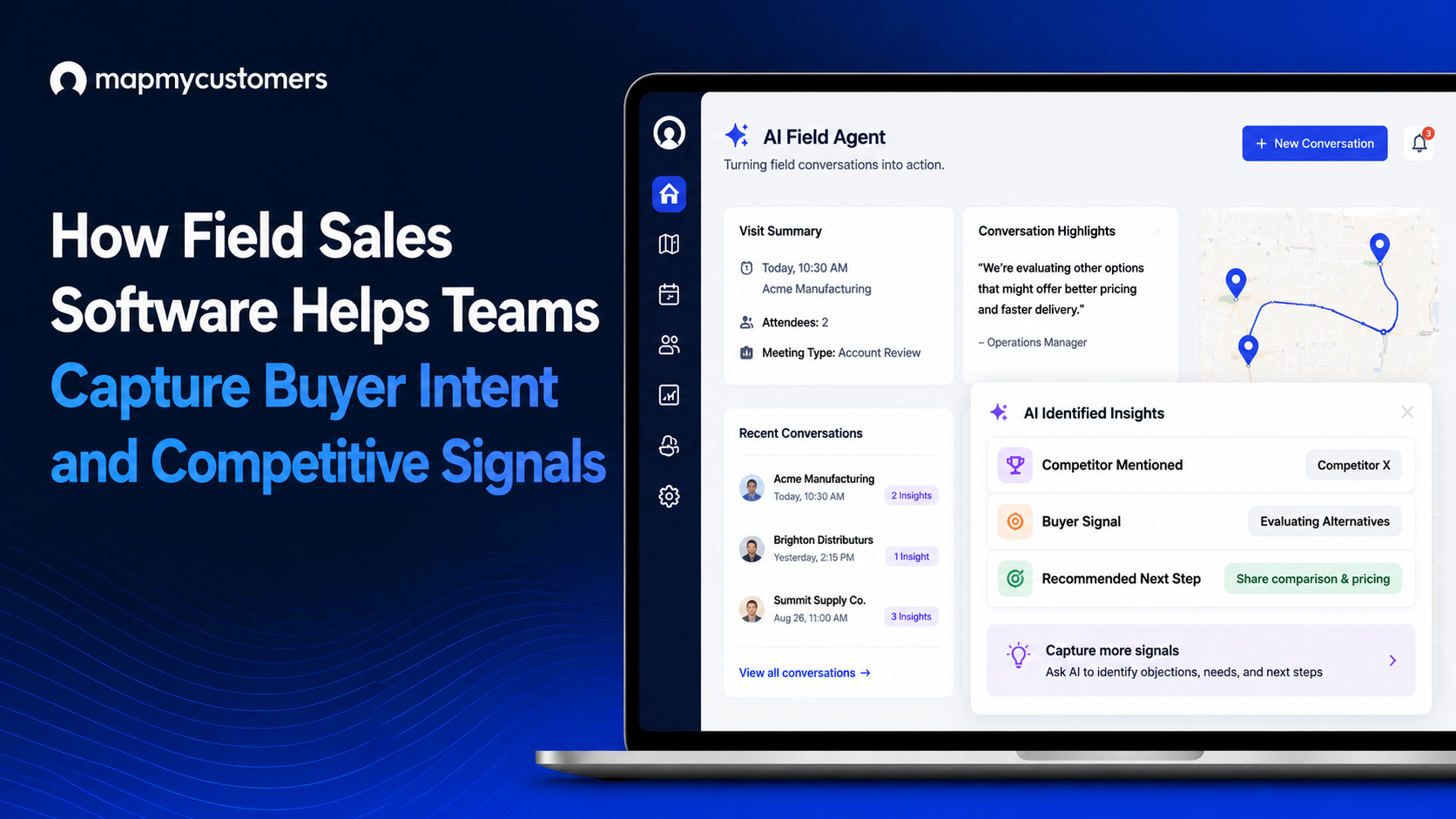
Field sales intelligence provides deeper context: “Top-performing representatives visit accounts with these characteristics, identify these buying signals, address these objections, and create these next steps.” AI-powered tools like the AI Field Agent are accelerating this shift by turning voice debriefs into structured insights and drafting follow-ups automatically.
That difference matters.
The most valuable data in field sales is not activity volume. It is the meaning behind the activity.
Organizations that capture field intelligence effectively can create a competitive advantage by turning thousands of customer interactions into strategic insight.
5 Best Practices for Surfacing Better Buyer Intent and Comparison Signals in Field Sales
- Create a structured process for capturing customer conversations. Do not rely on free-form notes alone. Define the specific signals sellers should capture, including competitors mentioned, customer priorities, buying concerns, decision criteria, and next steps. Consistency creates visibility.
- Track comparison behavior, not just opportunity stages. A buyer mentioning a competitor is valuable information. Create processes for identifying which competitors appear most often, which features buyers compare, which objections occur repeatedly, and which alternatives customers consider. This information can improve sales strategy and competitive positioning.
- Identify and replicate top seller behaviors. Look beyond revenue results. Analyze how top sellers prioritize accounts, use territory data, engage customers, and document insights. Turn those patterns into coaching opportunities.
- Connect field intelligence across departments. Customer insights should not remain inside sales. Create pathways for sharing field observations with marketing, product teams, customer success, and executive leadership. A single customer conversation can influence decisions across the organization.
- Choose technology that improves selling, not reporting. The best field sales software should make representatives more effective. Prioritize solutions that reduce administrative work, capture information quickly, provide actionable insights, improve territory visibility, and support better customer conversations.
The Competitive Advantage Hidden in the Field
Field sales teams have always possessed valuable market intelligence. The challenge has been capturing it, organizing it, and turning it into action.
As buying journeys become more complex, organizations need more than traditional CRM records. They need tools that connect customer conversations, seller behaviors, territory intelligence, and competitive signals.
Field sales software provides the foundation for that shift.
By making it easier for representatives to capture insights where selling happens, organizations can reduce administrative burden, improve manager visibility, and uncover the behaviors that drive growth.
The companies that succeed will not simply have more customer data. They will understand what that data means.
Ready to turn field conversations into competitive intelligence? Book a demo to see how Map My Customers helps teams capture buyer intent, surface competitive signals, and coach reps with real field data.