The Real Problem with Field Sales in 2026
Field sales software is a category of tools that helps outside sales reps manage accounts, plan routes, log activity, and sync data with their CRM from the field. It replaces manual spreadsheets and disconnected apps with a single mobile-first platform designed for reps who sell in person.
Key stat: Field sales reps spend less than 35% of their time actually selling. The rest disappears into manual route planning, CRM data entry, chasing down account history, and navigating disconnected apps.
That gap is not a motivation problem. It is a tooling problem.
The right field sales software does not just digitize a paper route sheet. It reclaims the hours lost to administrative drag, surfaces which accounts to visit and when, syncs everything back to your CRM without manual re-entry, and gives managers clear visibility into what is actually happening in the field.
The challenge is that the market has fragmented. There are tools built for door-to-door canvassing, tools built for Salesforce power users, tools built for retail merchandising, and tools built for solo reps on a budget. Using the wrong one for your motion is just as costly as using no tool at all.
This guide is a use-case-driven evaluation of 14 field sales tools, grouped by who they are actually best for. We did not write this to crown an overall winner. We wrote it so you can find the right tool for your specific team and sales motion, even if that means recommending a competitor for your situation.
How We Evaluated These Tools
Every tool in this guide was evaluated against eight criteria. Not every tool excels at every criterion, and that is intentional. The table below explains what we looked for and why it matters.
| Criteria | Why It Matters |
|---|---|
| Route Optimization | Reduces windshield time and helps reps visit more accounts per day without burning out |
| CRM Integration Depth | Two-way native sync vs. one-way or Zapier-only determines whether the field and the office share a single source of truth |
| Territory Management | Fair, balanced territories reduce rep attrition and prevent accounts from falling through the cracks |
| Mobile Experience | Field reps use their phones, not their laptops. A clunky mobile app destroys adoption |
| Pipeline and Deal Tracking | Knowing where each account sits in the funnel helps reps prioritize their days |
| AI Capabilities | Intelligent planning suggestions, automated insights, and proactive recommendations are increasingly table-stakes in 2026 |
| Reporting and Analytics | Managers need visibility into rep activity, territory performance, and revenue forecasting from the field |
| Pricing Transparency | Hidden pricing and complex licensing add friction and often hide true total cost of ownership |
Quick-Pick Comparison: All 14 Tools at a Glance
| Tool | Best For | Starting Price | CRM Sync | AI Features | G2 Rating |
|---|---|---|---|---|---|
| Map My Customers | B2B field sales teams | $60/user/mo | Native 2-way (SF, HubSpot, Zoho, Dynamics) | Smart Planner, AI Field Agent, Exec HQ | 4.5/5 |
| SPOTIO | D2D and B2C canvassing | Quote-based | Salesforce, HubSpot | Lead scoring, activity AI | 4.5/5 |
| Salesforce Maps | SF enterprise orgs | $75/user/mo + SF license | Native SF only | Agentforce integration | 4.2/5 |
| SalesRabbit | D2D B2C sales | $59/user/mo | One-way SF | DataGrid AI | 4.2/5 |
| Geopointe (Ascent Cloud) | Salesforce-only teams | $225/mo flat (1-24 users) | Native SF only | Insights AI | 4.2/5 |
| Maptive | Data viz and territory planning | ~$104/mo individual | Live Salesforce sync | Maptive iQ | 4.5/5 |
| RepMove | Solo reps, small teams | Free plan available | Basic integrations | None listed | 4.3/5 |
| Repsly | Retail and merchandising | Contact for pricing | Salesforce, HubSpot | Execution analytics | 4.4/5 |
| Skynamo | Wholesale and distribution | Custom pricing | ERP + Salesforce | Route automation | 4.3/5 |
| Pitcher | Enterprise guided selling | Custom pricing | SAP, Salesforce | Content AI | 4.1/5 |
| Pepperi | B2B consumer goods | Enterprise pricing | SAP, Salesforce | Order AI | N/A |
| Mapsly | Lightweight CRM mapping | $25/user/mo | 20+ CRM integrations | Basic | 4.6/5 |
| Ecanvasser | Canvassing and field ops | Lead-based pricing | Limited | None listed | 4.1/5 |
| ForceManager | AI activity logging | Custom pricing | Salesforce, HubSpot | AI note summarization | 4.3/5 |
Detailed Reviews by Use Case
 1. Map My Customers
Map My Customers is a purpose-built field sales platform designed for B2B outside sales teams managing complex accounts across a defined territory. It is not a lightweight mapping add-on or a vertical-specific canvassing tool. It was built from the ground up to solve the specific problems that B2B reps face: too many accounts, not enough time, and a CRM that the field does not trust because it is always out of date.
What sets Map My Customers apart is the combination of route optimization, native two-way CRM sync, territory management, and AI-powered planning in a single mobile-first platform. Most competitors do one or two of those things well. Map My Customers does all of them.
Route Optimization and Smart Planner
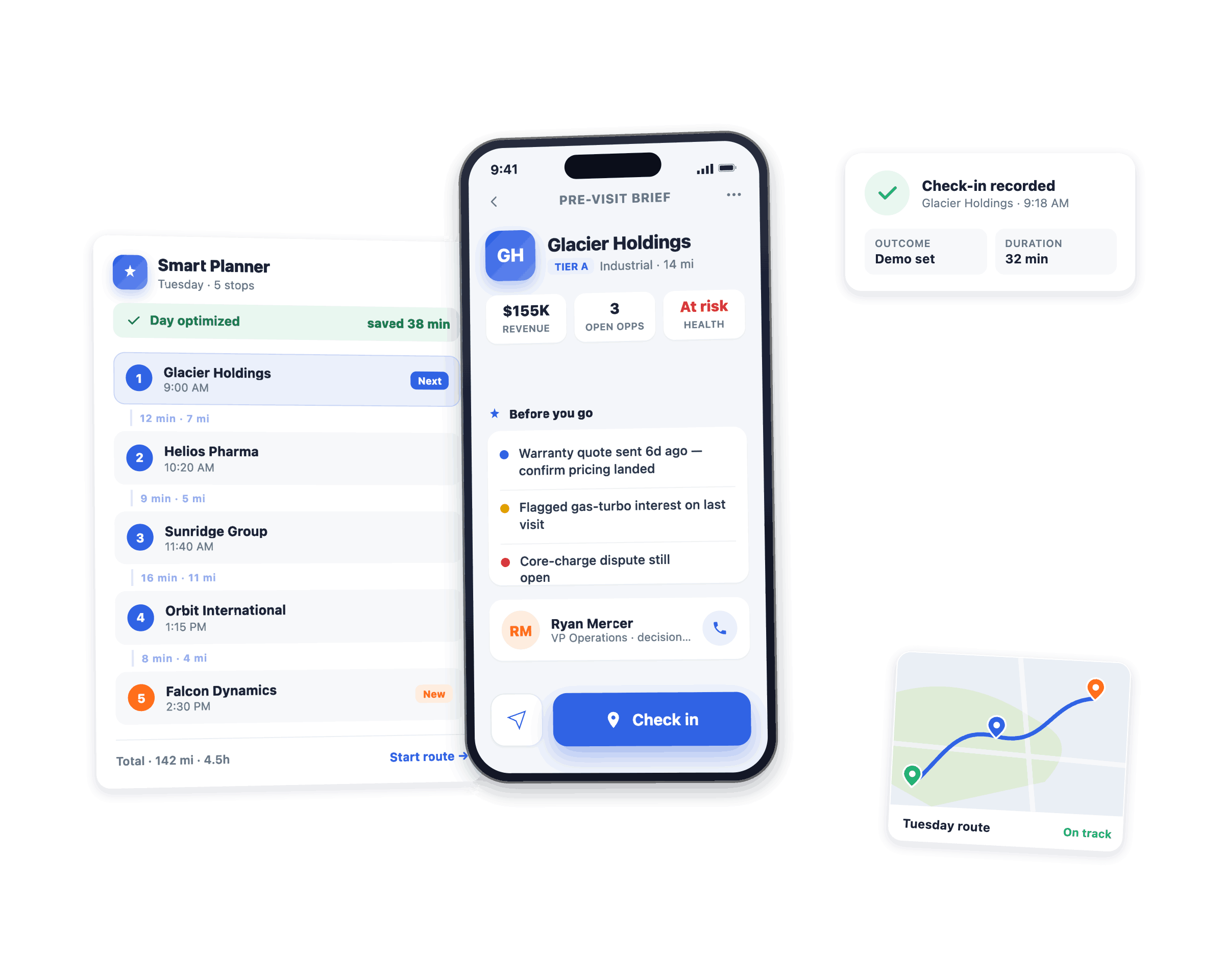
The route optimization engine allows reps to build optimized multi-stop routes directly from their account map. They can filter by account type, priority, owner, last visit date, or custom fields pulled from their CRM, then build a route from that filtered view with a single tap.
The Smart Planner goes further. Rather than waiting for a rep to decide who to visit, Smart Planner proactively surfaces account recommendations: accounts that are overdue for a visit, high-value accounts nearby the rep’s current location, or accounts with open opportunities that have gone quiet. Reps can accept those suggestions and convert them into an optimized route without leaving the app.
Pre-visit briefs give reps a quick summary of an account before they walk in the door: recent activity, deal stage, last note logged, and any open tasks. This eliminates the scramble to find the right information mid-commute.
AI Field Agent
The AI Field Agent acts as an in-app co-pilot for reps in the field. After every visit, reps can talk through what happened using voice debriefs instead of typing notes. The AI transcribes and structures the conversation into summaries with key takeaways, action items, and CRM-ready updates.
It also drafts instant follow-up emails based on the debrief content and account context, reducing what used to take 10 minutes of post-visit typing to a quick review and send. Between stops, the assistant suggests smart route adjustments based on account history and visit outcomes, reordering the day’s schedule to improve coverage.
CRM Integration
Map My Customers offers native two-way sync with Salesforce, HubSpot, Zoho CRM, and Microsoft Dynamics. Two-way means field activity flows back into the CRM automatically, and CRM data flows into the app in real time. Reps do not re-enter data. Managers do not see a stale CRM.
This is a meaningful differentiator. Most competitors offer one-way sync or rely on Zapier for integration. When a rep logs a visit, books a follow-up, or updates a deal stage in Map My Customers, that update appears in Salesforce (or whichever CRM) without any manual action. The field and the office work from the same data.
Territory Management
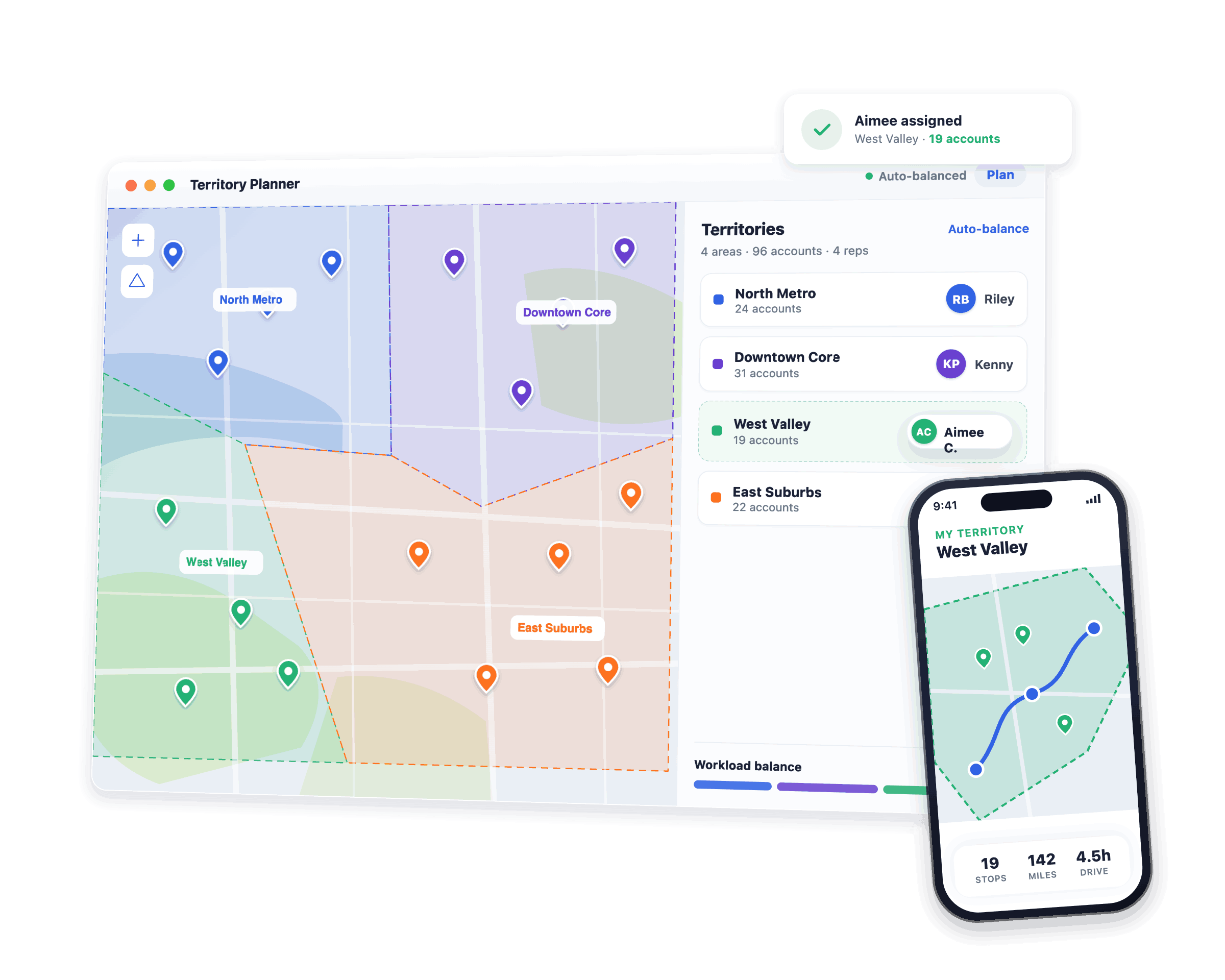
The territory builder allows managers to draw territories by geography, assign accounts by rep, and balance workload across the team. The workload balancing feature shows how many accounts, opportunities, and visits are assigned per rep so managers can redistribute before territories become inequitable.
Territories can be updated and reassigned without disrupting historical activity data. When a rep leaves, their accounts and history can be cleanly handed to their replacement.
Analytics and Reporting
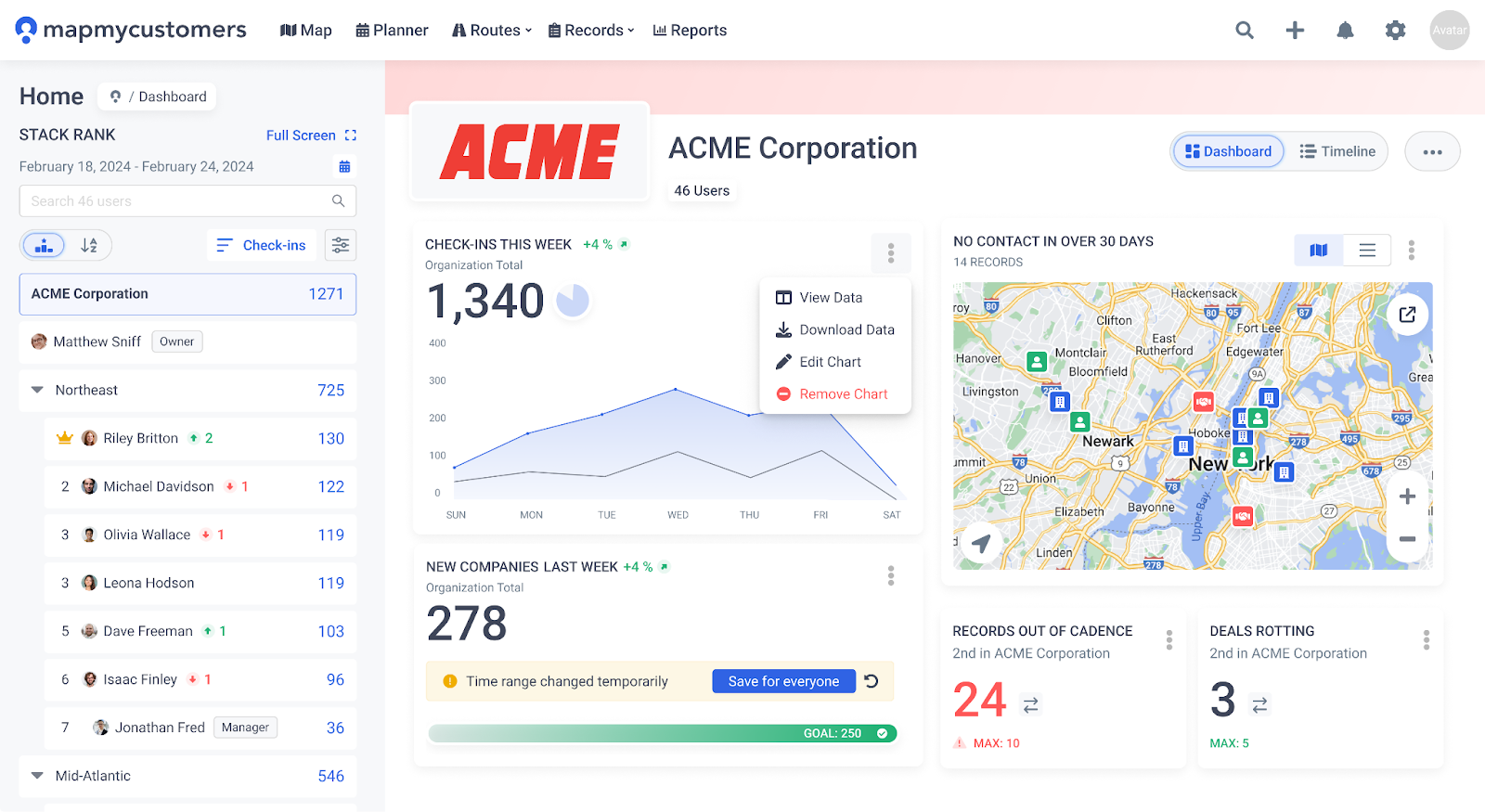
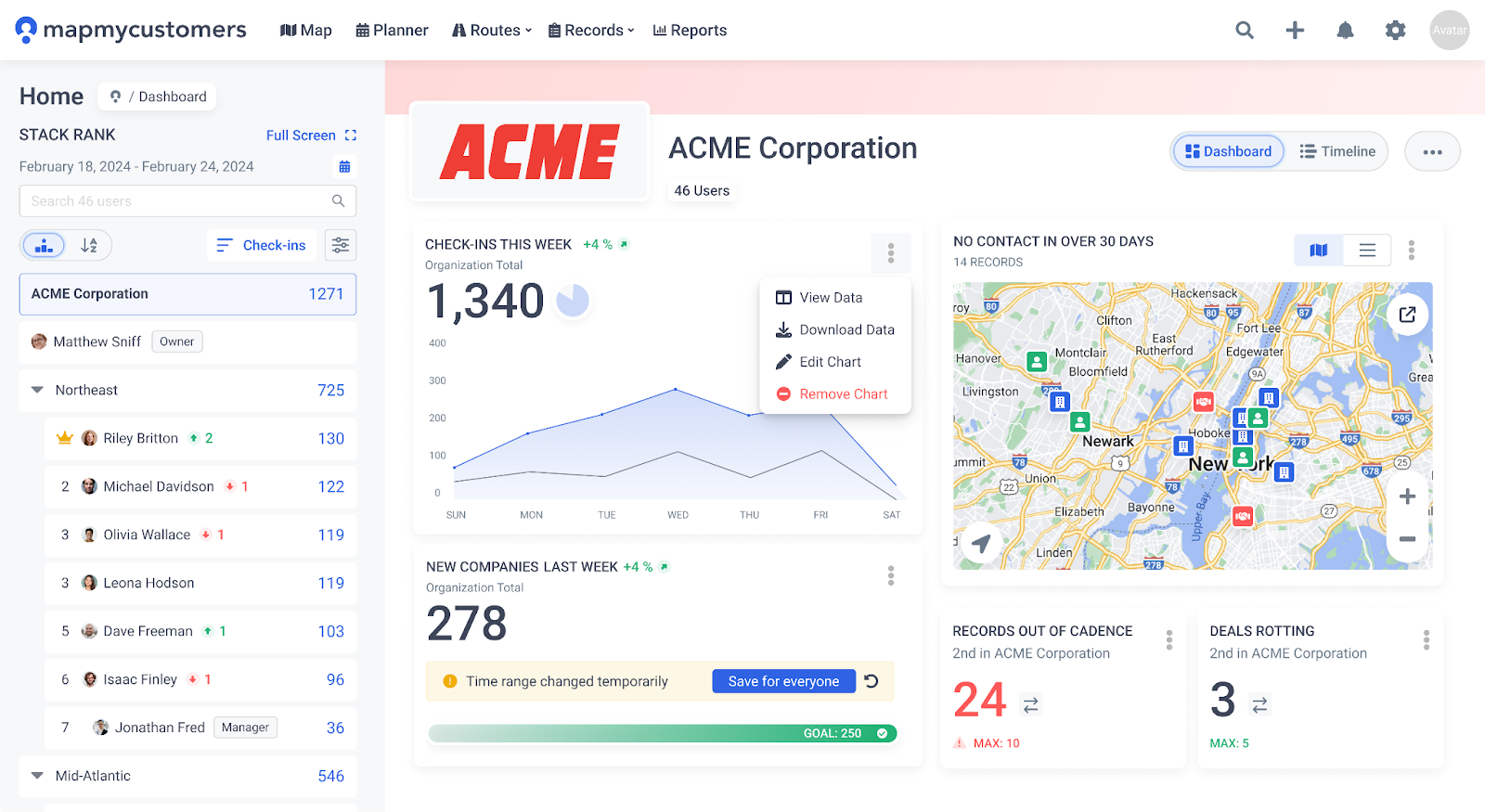
Map My Customers includes 40+ pre-built analytics charts covering rep activity, territory performance, visit frequency, pipeline health, and revenue trends. The Weekly Scorecard automatically summarizes each rep’s activity for the prior week and emails it to managers without any manual report building.
Frequency management allows managers to set minimum visit cadences by account type. The system flags accounts that have fallen out of cadence and surfaces them as Smart Planner recommendations, closing the loop between strategy and execution.
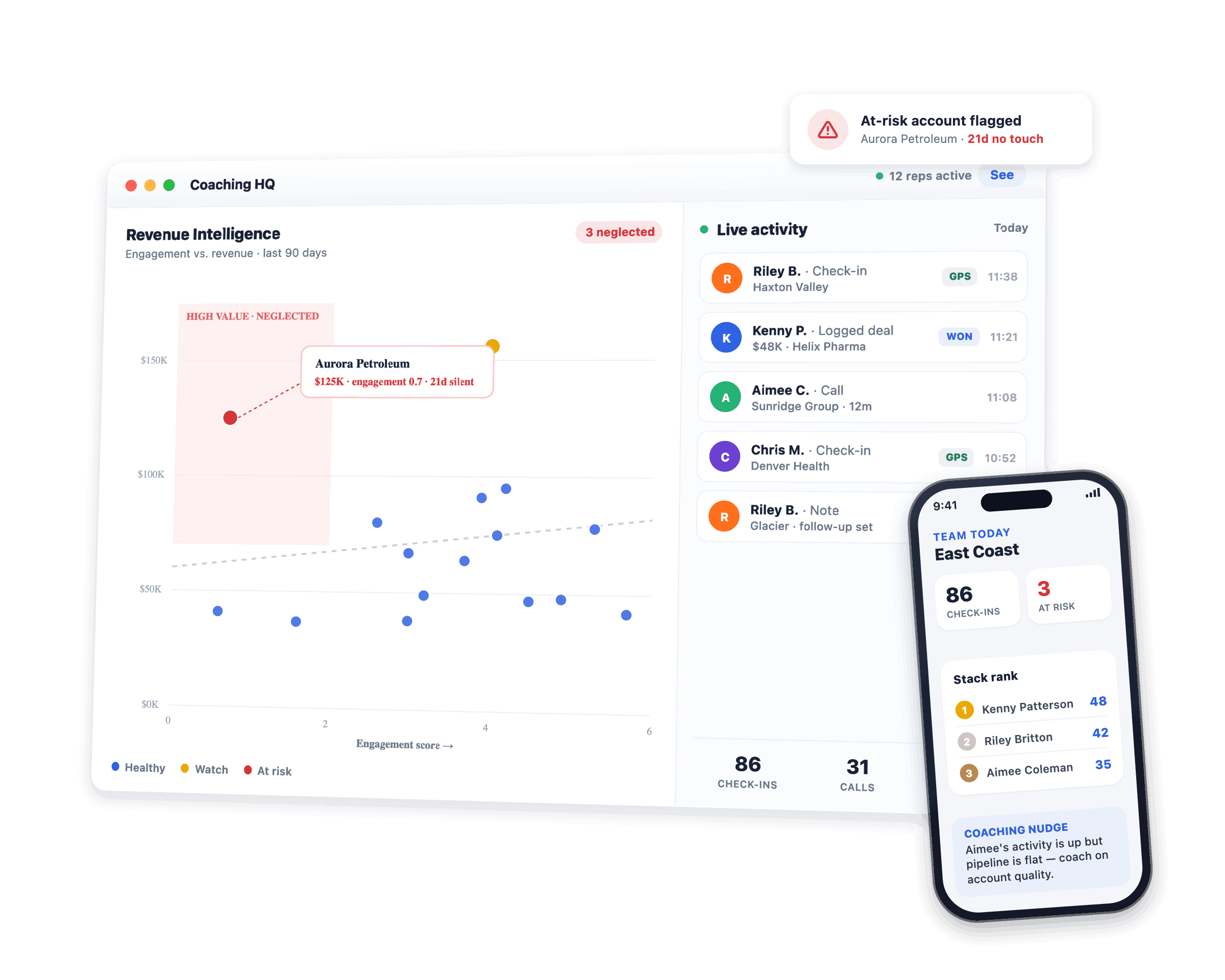
The Coaching HQ dashboard gives managers a rep-by-rep view of activity metrics, pipeline health, and territory coverage. This makes 1:1 coaching conversations more specific and less reliant on anecdote.
Exec HQ for Sales Leadership
Exec HQ is the command layer built for VPs and sales leaders who need executive-grade visibility without opening a separate BI tool. Instead of exporting field data to Tableau or Power BI, Exec HQ embeds it where the team already works.
Key capabilities include Order and Revenue Insights that connect revenue data directly to rep behavior with account engagement scoring, AI-generated Executive Summaries that synthesize field activity into narratives delivered on a schedule, and Coaching and Tasks that let leaders assign feedback tied to specific accounts with due dates and completion tracking. Each Exec HQ deployment is built bespoke to the customer’s data sources and success criteria.
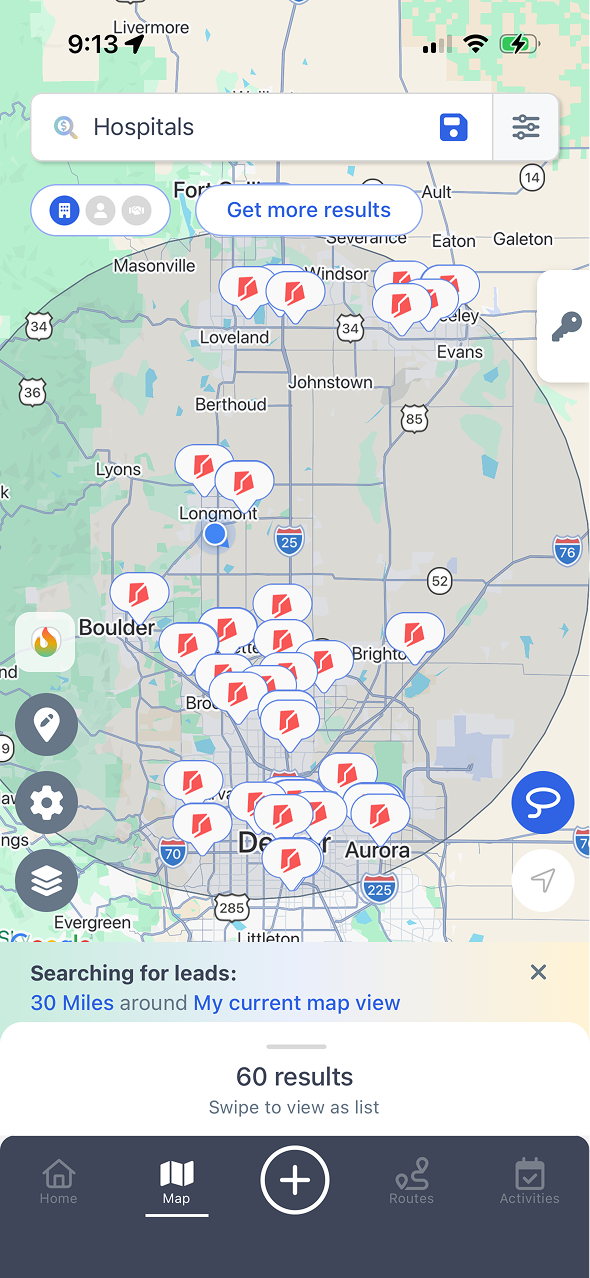
Lead Finder
Lead Finder allows reps to discover new prospects directly on the account map, filtered by business category, geography, and proximity to current route stops. Rather than returning to the office to research new leads, reps can identify and add prospects from the field and immediately add them to their route or CRM pipeline.
Additional Features
- Mileage tracking with IRS-compliant mileage logs, exported per trip or per period
- Email tracking that connects outbound emails to account records
- Check-in activity logging with custom fields, notes, and photo attachments
- Offline mode for areas with poor cell coverage
- Hands-on onboarding and dedicated support included on paid plans
Pricing
- Personal: $60/user/month
- Team: $105/user/month
- Annual billing available with a discount
Pros
- Purpose-built for B2B outside sales, not repurposed from another use case
- Transparent, per-user pricing with no hidden licensing fees
- Native two-way CRM sync without Zapier or middleware
- Smart Planner actively helps reps prioritize, rather than just organizing what they already know
- AI Field Agent eliminates post-visit admin with voice debriefs and instant follow-up drafting
- Exec HQ gives leadership executive-grade visibility without a separate BI tool
- Hands-on onboarding reduces the time to adoption
Cons
- Not designed for door-to-door canvassing or residential sales
- No household demographic data for B2C lead qualification
- Smaller enterprise customization options compared to Salesforce Maps
G2 Rating: 4.5/5
For a direct comparison with SPOTIO, see our Map My Customers vs. SPOTIO breakdown.
 2. Salesforce Maps
Salesforce Maps (now being rebranded under the Agentforce Sales umbrella) is the mapping and territory planning layer built directly into the Salesforce platform. For organizations already deeply invested in Salesforce, it offers native access to all SF data objects without an additional integration layer.
Important 2026 update: Salesforce announced that the standalone Salesforce Maps mobile app will be retired on August 31, 2026. Going forward, field functionality will be accessed through the Salesforce mobile app directly. Organizations currently relying on the standalone app need to migrate before the deadline.
Salesforce Maps Base starts at $75/user/month on top of an existing Salesforce license. Advanced tier runs $150/user/month. For a 10-person team with Professional Salesforce licenses, total cost can exceed $4,000 per month.
The platform excels at enterprise territory planning, advanced data visualization, and native access to every SF object. The learning curve is steep, and configuration typically requires a Salesforce admin. It is not a tool that field reps set up themselves.
Pros: Deepest Salesforce integration available, enterprise-grade territory planning, no data sync issues since it lives inside SF Cons: Expensive total cost of ownership, complex setup, standalone mobile app retiring August 2026, no value outside of Salesforce environments
G2 Rating: 4.2/5
For more detail, see our Salesforce Maps review and our roundup of Salesforce Maps alternatives.
 3. SPOTIO
SPOTIO now positions itself as an “AI-Powered Field Sales Execution Platform.” Its roots are firmly in door-to-door and residential canvassing, and that heritage shapes the product: pin dropping for canvassed areas, lead status tracking by household, and team activity visualization on a live map.
SPOTIO has invested in AI-powered lead scoring and activity recommendations to help reps prioritize which doors to knock based on previous visit outcomes and demographic data. SPOTIO is actively expanding into B2B, but its feature set and workflows still skew toward high-volume, low-complexity D2D motions.
Pricing moved to fully quote-based in late 2025. Previous published tiers ranged from $39 to $129/user/month; current pricing requires a sales conversation.
For canvassing teams working residential territory, SPOTIO is one of the strongest options available. For B2B teams managing complex accounts, it is less well-suited. See our SPOTIO review for a detailed breakdown.
Pros: Strong canvassing workflows, AI-assisted lead targeting, real-time team map visibility Cons: Quote-based pricing adds friction, B2B features are still maturing, no transparent pricing page
G2 Rating: 4.5/5
 4. SalesRabbit
SalesRabbit is a door-to-door sales platform built for high-volume residential teams. Colored map pins track which homes have been contacted and the outcome of each visit. Real-time team monitoring lets managers see rep locations and activity on a live map.
In 2026, SalesRabbit raised prices and launched RoofLink Pro, an add-on for roofing sales teams that integrates aerial imagery and property data into the canvas workflow. The DataGrid AI feature helps reps qualify homeowners by surfacing demographic and property data before knocking.
The Salesforce integration is currently one-way: data pushes from SalesRabbit to Salesforce but does not pull back. Teams managing opportunities in SF will need to verify data accuracy.
Pricing: $59/user/mo (Team), $75/user/mo (Pro), Enterprise custom.
See our SalesRabbit review for a detailed breakdown.
G2 Rating: 4.2/5
 5. Ecanvasser
Ecanvasser was originally built for political canvassing and has expanded into field sales for teams that need to systematically work geographic areas door-to-door. Its standout feature is route optimization supporting up to 200 stops, which is significantly more than most competitors support natively.
Ecanvasser uses lead-based pricing rather than per-user pricing, which can make it cost-effective for large canvassing teams. It is not designed for complex B2B account management and lacks deep CRM integration, but for teams that need to cover ground efficiently and track household-level contact data, it is a capable option.
 6. Geopointe (Ascent Cloud)
Geopointe was one of the original Salesforce mapping tools and has operated for over a decade as a pure Salesforce AppExchange application. In 2025, it was rebranded under the Ascent Cloud umbrella alongside other Salesforce-native tools.
The rebrand brought a restructured pricing model: a new flat rate of $225/month for 1 to 24 users, replacing the previous per-user pricing. For teams of 10 to 24, this represents a significant reduction in per-seat cost. The new pricing includes Geopointe’s mapping and territory features, the new Insights AI module, and the Integration Engine for connecting non-Salesforce data sources.
Geopointe requires an active Salesforce subscription. It does not function as a standalone tool. Organizations that are committed to Salesforce as their CRM and want territory planning, route optimization, and data visualization within that ecosystem will find Geopointe a strong fit.
For teams that want to evaluate Geopointe before committing, see our Geopointe pros and cons review.
G2 Rating: 4.2/5
 7. Maptive
Maptive is a web-based mapping platform that excels at turning spreadsheet data and CRM exports into interactive territory maps, heat maps, and route visualizations. In 2026, Maptive launched Maptive iQ, which adds AI-powered territory analysis and, notably, live two-way Salesforce sync, a significant upgrade from the previous manual import/export workflow.
Individual annual plans start at approximately $104/month. Team plans are available at higher tiers.
Maptive is strongest as a territory planning and data visualization layer. It is less focused on the day-to-day field rep workflow (mobile check-ins, visit logging, real-time coaching) and more suited for managers and ops teams who need to understand geographic performance data and plan territory coverage.
See our Maptive review for a detailed breakdown.
G2 Rating: ~4.5/5
 8. Mapsly
Mapsly is a lightweight CRM mapping tool that integrates with more than 20 CRMs, including Salesforce, HubSpot, Pipedrive, and others. It is designed for teams that want to visualize their CRM accounts on a map, filter by custom fields, and build optimized routes without a complex setup or steep learning curve.
Pricing ranges from $25 to $70/user/month, making it one of the more affordable options for teams that need basic mapping and routing without the full feature set of a dedicated field sales platform. It lacks the territory workload balancing, AI-powered planning, and coaching dashboards of more comprehensive platforms, but for smaller teams that just need to see accounts on a map and plan efficient routes, it covers the basics well.
 9. Repsly
Repsly is purpose-built for consumer goods, CPG, and retail field teams. Where most field sales tools focus on B2B account management or D2D canvassing, Repsly focuses on in-store execution: verifying shelf placement, capturing photos, completing merchandising checklists, and scheduling retail visits on optimized routes.
The platform includes real-time coaching via direct messaging, flexible scheduling tools, and strong reporting on retail execution metrics. It integrates with Salesforce and HubSpot. Pricing is available on request.
For retail and CPG field teams, Repsly is one of the most purpose-fit options available. For B2B or D2D teams, it is not the right fit.
 10. Skynamo
Skynamo is designed for wholesale, manufacturing, and distribution sales teams. It automates route planning, order capture, and admin tasks for reps who call on trade accounts, run van sales routes, or manage distributor relationships.
A key differentiator is full offline functionality: reps can browse accounts, log visits, capture orders, and sync data without a cell signal, which matters for teams working in warehouses, rural areas, or facilities with poor connectivity. Skynamo integrates with major ERP systems as well as Salesforce. Pricing is custom based on team size and configuration.
 11. Pitcher
Pitcher is an enterprise field sales enablement platform with strong traction in pharmaceutical, life sciences, and medical device sales. It combines guided selling flows, content management, and CRM integration (SAP, Salesforce) with mobile-first field execution. An AI layer helps surface the right content and recommended talk tracks for each account visit.
Pitcher is not a lightweight routing tool. It is a full enterprise platform with corresponding pricing and implementation complexity. Best suited for regulated industries where content compliance and guided selling workflows are as important as routing efficiency.
 12. Pepperi
Pepperi targets B2B consumer goods companies and wholesale distributors. It combines field sales execution with mobile order management, route accounting, and van sales capabilities. Reps can take orders, process returns, and capture in-store activity from a single mobile app that integrates with SAP and Salesforce.
For companies that need field sales execution and mobile order entry in one platform, Pepperi addresses a gap that most pure field sales tools do not cover. Pricing is enterprise-tier.
 13. RepMove
RepMove is a lightweight field sales app designed for individual reps and very small teams. The free plan includes basic account management, visit logging, and route planning, making it the most accessible entry point in this category for reps who are not yet ready to commit to a paid platform.
Paid tiers add CRM integrations, team visibility features, and more advanced reporting. RepMove does not have the AI planning features, territory management depth, or analytics of larger platforms, but for a solo rep building a territory from scratch, the free plan removes the financial barrier to getting organized.
 14. ForceManager
ForceManager is an AI-powered field sales CRM with strong adoption in European and Latin American markets. Its standout feature is automatic visit detection: the app uses GPS and calendar data to detect when a rep is at a customer location and prompts them to log the visit, rather than requiring manual check-in. An AI note summarization feature converts spoken or typed notes into structured CRM updates.
ForceManager is mobile-first and designed to minimize admin burden for reps in the field. It integrates with Salesforce and HubSpot. Pricing is custom. For teams looking for a field-first CRM rather than a field layer on top of an existing CRM, ForceManager is worth evaluating.
How to Choose: A Decision Framework
With 14 tools and dozens of variables, choosing the right platform comes down to four questions: What is your sales motion? What CRM are you already using? How large is your team? And what is the biggest pain point you are solving?
Use this framework to narrow the field.
If you run B2B field sales with complex accounts: Map My Customers is the strongest fit. It is purpose-built for managing named accounts, optimizing multi-stop routes, and syncing field activity back to your CRM without manual re-entry. Its Smart Planner and territory workload balancing are designed specifically for teams managing 50 to 500+ accounts per rep.
If your organization runs entirely on Salesforce and will not leave: Start with Geopointe (Ascent Cloud) if you want cost-effective territory mapping and are a team of fewer than 25. Consider Salesforce Maps (Agentforce Sales) if you are a large enterprise and need the deepest possible SF data access, but plan for a significant investment and migration off the retiring mobile app before August 31, 2026.
If you run door-to-door residential canvassing: SPOTIO and SalesRabbit are the two most established options for canvassing teams, with SalesRabbit gaining ground in the roofing vertical through RoofLink Pro. Neither is a good fit for B2B account management.
If your need is data visualization and territory planning for ops or managers: Maptive’s new iQ layer with live Salesforce sync makes it the strongest choice in 2026 for teams that need geographic analytics without a full field rep workflow.
If you sell into retail, CPG, or distribution: Repsly for retail execution and in-store merchandising. Skynamo for wholesale, van sales, and distribution. Pepperi if you need mobile order management alongside field execution.
If you are a solo rep or a team of fewer than five: RepMove’s free plan removes the cost barrier. Mapsly at $25/user is a step up with broader CRM support. Neither has the full feature depth of enterprise platforms, but both are far better than spreadsheets and Google Maps.
For teams evaluating route optimization tools specifically, see our route planner roundup.
What Changed in 2026: The Market Update
The field sales software market moved quickly over the past 12 months. Here is what changed since last year’s guide and why it matters for your buying decision.
SPOTIO added AI-powered lead scoring
SPOTIO has added AI capabilities focused on lead prioritization and canvassing pattern analysis. For D2D teams, this helps reps target higher-probability doors rather than relying on purely geographic routing.
GeoMapper acquired by HubSpot, closed to new signups (July 2025)
GeoMapper, a HubSpot-native mapping tool that was popular with HubSpot shops, was acquired by HubSpot in July 2025. The tool is now closed to new signups. Existing subscribers may continue but the long-term roadmap is unclear. Teams that relied on GeoMapper should evaluate Map My Customers or Mapsly as HubSpot-integrated alternatives. See our GeoMapper review for context on what to migrate.
Geopointe rebranded to Ascent Cloud with flat-rate pricing
The Ascent Cloud rebrand consolidated Geopointe with other Salesforce-native tools under one vendor. More practically, the shift to a flat $225/month rate for teams of 1 to 24 users changed the economics significantly. Teams that previously paid per-user are re-evaluating.
Salesforce Maps mobile app retiring August 31, 2026
This is the most time-sensitive change in the market. Any organization using the standalone Salesforce Maps mobile app needs to complete migration to the Salesforce mobile app before August 31, 2026. Failure to migrate will result in field reps losing access to their primary work tool. If your team is affected, start the migration process now.
SalesRabbit raised prices and launched RoofLink Pro
SalesRabbit’s price increases reflect the platform’s expanded feature set, but some smaller D2D teams have been pricing off the platform. RoofLink Pro adds aerial imagery and property data for roofing sales teams, making SalesRabbit a more compelling vertical solution in that niche.
Maptive launched iQ with live Salesforce sync
Previously, Maptive users had to manually import and export data between Salesforce and the platform. The Maptive iQ launch in 2026 added live bidirectional Salesforce sync, closing a significant gap and making Maptive a much stronger option for Salesforce organizations that need territory visualization without a full field rep execution layer.
Frequently Asked Questions
What is field sales software?
Field sales software is a category of tools that helps outside sales reps manage their accounts, plan routes, log activity, and sync data with their CRM from the field. Unlike desktop CRMs, field sales software is designed for mobile-first use, with maps, route optimization, check-in workflows, and offline capability as core features. It bridges the gap between what happens in the field and what managers see in the office.
What is the best field sales app for B2B teams?
For B2B outside sales teams managing complex accounts across a defined territory, Map My Customers is the strongest fit in 2026. Its combination of Smart Planner AI, native two-way CRM sync with Salesforce, HubSpot, Zoho, and Dynamics, territory workload balancing, and 40+ analytics charts is purpose-built for B2B account management. For D2D canvassing, SPOTIO leads the category.
How much does field sales software cost?
Pricing ranges widely depending on team size and feature set. Entry-level tools like RepMove offer free starter plans. Mid-market platforms like Map My Customers (from $60/user/mo) and Mapsly (from $25/user/mo) publish transparent per-user pricing. Enterprise platforms like SPOTIO, Salesforce Maps, and Geopointe use quote-based pricing that typically reflects higher total cost. Budget for $60 to $150 per user per month for a full-featured platform.
Does field sales software integrate with Salesforce?
Most leading field sales tools offer Salesforce integration, but the depth varies considerably. Map My Customers and Geopointe offer native two-way sync. SalesRabbit’s integration is currently one-way. Some tools use middleware like Zapier, which adds latency and complexity. Before selecting a tool, confirm whether the Salesforce integration is native and bidirectional, or whether it requires third-party connectors.
What is the difference between field sales software and a CRM?
A CRM (Customer Relationship Management) system is a database for storing contacts, companies, deals, and activity history. Field sales software layers on top of a CRM to add capabilities specific to the field: route optimization, territory mapping, mobile check-ins, visit frequency management, and geographic analytics. The two categories are complementary. Most field sales platforms do not replace a CRM but integrate with one to ensure the field and the office share a single source of truth.
Do field sales reps need route optimization?
Key stat: Field sales reps spend an average of 22 hours per week driving.
Route optimization directly reduces that number by finding the most efficient stop sequence for each day, accounting for traffic, appointment timing, and priority accounts. Reps using optimized routes typically visit two to four more accounts per week without extending their working hours. For teams with 20+ accounts per rep, route optimization is not optional, it is a competitive requirement.
What is the best free field sales app?
RepMove offers the most capable free plan for individual field reps, with basic account mapping, visit logging, and route planning included at no cost. Maptive offers a limited free trial for teams wanting to test territory visualization. Most full-featured platforms (Map My Customers, SPOTIO, Salesforce Maps) do not offer permanent free plans but provide free trial periods.
How do I get my team to actually use field sales software?
The most common adoption failure comes from tools that add steps to a rep’s workflow rather than removing them. Choose platforms with mobile-first design, automatic data sync (so reps are not manually re-entering information), and visible daily time savings. Involve reps in the evaluation process. Connect the software’s output to conversations managers already have with reps (visit frequency, pipeline health, territory coverage). Map My Customers includes hands-on onboarding support on all paid plans, which meaningfully accelerates adoption.
What features should I look for in field sales software?
The non-negotiables for most B2B teams are: native two-way CRM integration, optimized multi-stop routing, territory management with workload visibility, mobile activity logging, visit frequency tracking, and reporting dashboards. In 2026, AI-powered planning (like Smart Planner) and coaching dashboards (like Coaching HQ) are increasingly differentiating features rather than nice-to-haves. Avoid tools that require Zapier for CRM sync or that only offer one-way data flow.
Is SPOTIO or Map My Customers better for B2B?
For B2B field sales teams managing named accounts with complex sales cycles, Map My Customers is the stronger fit. It is purpose-built for the B2B motion: territory management, multi-decision-maker account tracking, frequency management, and native CRM sync all reflect B2B account complexity. SPOTIO focuses on door-to-door and residential canvassing, where its household-level data and canvassing workflows serve a different sales motion. The right tool depends on how your team sells.
The Bottom Line: Which Tool Should You Choose?
The best field sales software is the one built for your specific motion.
There is no universal winner in this category. Different tools serve different sales motions. Geopointe is the right answer for Salesforce shops that need territory mapping without leaving the SF ecosystem. Repsly serves retail merchandising teams well. RepMove removes the barrier for solo reps who just need to get organized.
What we can say with confidence: if you run a B2B field sales team managing complex accounts across a territory, Map My Customers was built for you. Transparent pricing, native two-way CRM sync, Smart Planner AI, and hands-on onboarding support make it the most complete B2B field sales platform available in 2026.
The next step is simple: see it in action with your own accounts and your own CRM data.
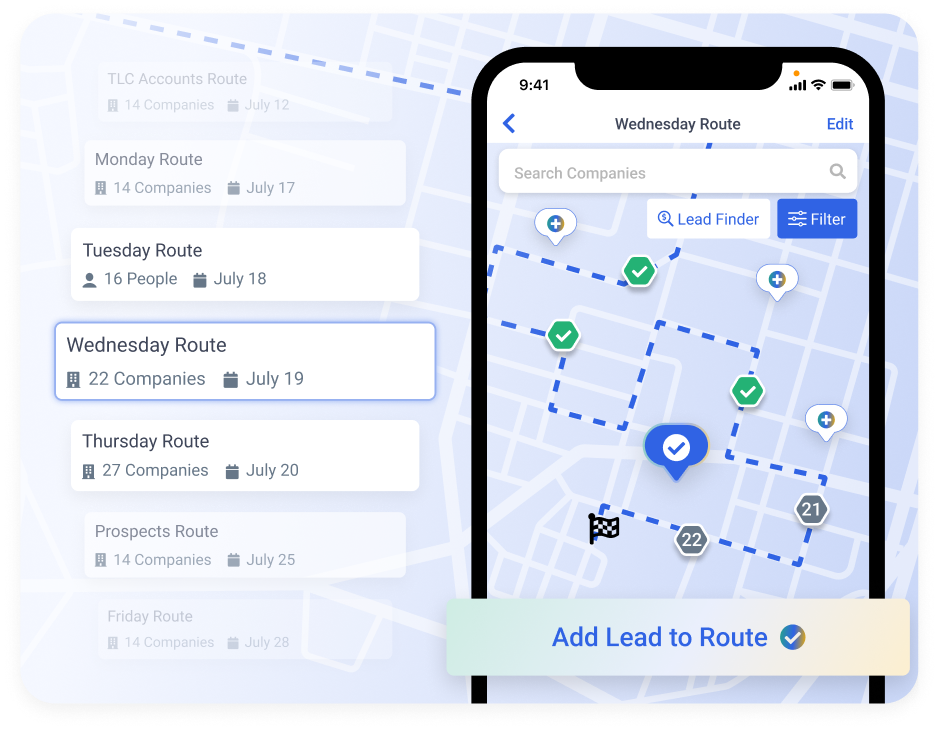
Book a personalized demo and see Map My Customers in your territory.
Your field reps are spending less than 35% of their time selling. The right software changes that number. Let us show you how.