Every December, someone in sales ops opens the same spreadsheet. They export the account list, sort it by zip code and revenue, and move accounts between reps until the columns look even. By mid-January the new map goes out, quotas get attached to it, and everyone gets back to selling.
Sales territory realignment is the process of reassigning accounts, geography and visit workload among field reps so each territory has a fair share of opportunity and a rep can cover it. Most teams do it once a year, before new quotas are set.
I’ve watched a lot of teams go through this. The territory map is usually the most carefully planned thing in the whole sales year. What happens inside each territory after January gets far less attention, and that’s where I think 2027 gets won or lost.
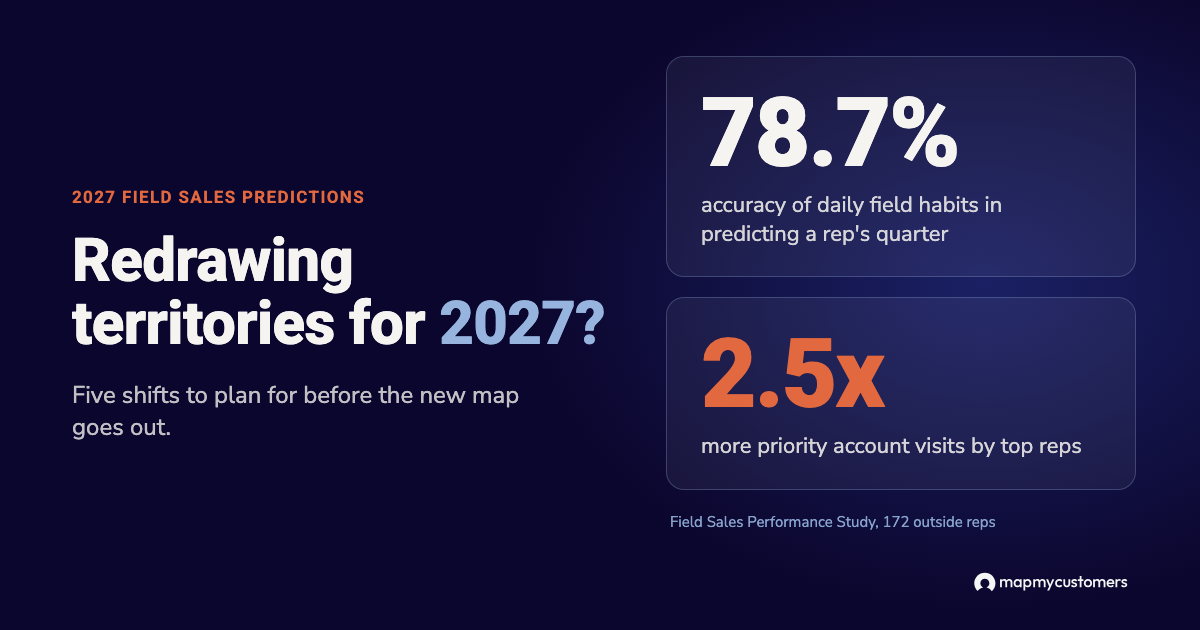
When we studied 172 outside reps at Jasper Engines & Transmissions with an NYU data scientist, their daily field habits predicted whether their quarter would grow or decline with 78.7% accuracy (Field Sales Performance Study). The territory gave each rep a set of accounts. What the rep did with those accounts every day is what showed up in the number, and it showed up weeks before the revenue did.
With that in mind, here are five shifts I expect in 2027, and what each one means for the plan you’re building right now.
1. Territories stop being a once-a-year project
Most teams realign once a year and then live with the result. That plan breaks the first time a rep leaves in March. Their accounts get split among whoever has room, usually by geography, and nobody looks at it again until December. In the meantime, some of those accounts go a month or two without a visit.
In 2027 I expect more sales ops teams to rebalance whenever headcount, account value or coverage changes, instead of waiting for the annual reset. Leaders now want to see territory health every week, so a lopsided territory gets caught in a few weeks instead of at year end.
Before you finalize this year’s map, write down how a departing rep’s accounts will be reassigned. You’ll need that rule sooner than you think. (We wrote about splitting a territory when a new rep starts, which covers the same decisions in reverse.)
2. Coverage becomes the first number leadership asks about
Revenue tells you how last quarter went. Coverage tells you how this one is going: which priority accounts have been seen on schedule, which have gone quiet and where the gaps are on the map.
In our study, top reps visited priority accounts 2.5 times as often as lower performers and logged three times as much field activity. The difference was visible in their activity long before it was visible in their results.
I think 2027 is the year coverage moves into the weekly leadership meeting. It’s the one number you can still act on while there’s time to change the quarter. If you’re deciding what to track, start with these sales territory management metrics.
3. Dormant accounts become the first place teams look for growth
Distribution and building materials teams have spent the last two years dealing with price swings and tariff uncertainty, and price increases carried a lot of their revenue growth. When pricing stops driving growth, it has to come from volume. The most reachable volume is usually in accounts that used to buy and stopped.
Most of those accounts didn’t leave in one decision. The visits slowed down first, and the orders followed a few months later. When you redraw territories, put last-visit date and order history side by side, pick the dormant accounts that still have real potential and give them a visit cadence like any other priority account. Winning back a customer who already knows your product usually takes fewer visits than opening a new one.
4. In healthcare, visits get rationed
Medical device and diagnostics reps already live with this. Credentialing requirements, limited OR access and full physician schedules make face time harder to get and easier to lose.
That changes how a healthcare territory should be built. A 2027 plan needs to rank which sites deserve those limited visits and route each day so reps reach them when access is open. A wasted visit costs more when you only get a few each month.
5. AI moves out of the CRM and into the rep’s day
Most sales AI so far has lived at a desk, summarizing calls and drafting emails inside the CRM. Field reps spend their day in a car and in customers’ buildings. The AI that helps them answers practical questions between stops: which accounts near me are overdue, what happened at the last visit, what should I bring up today.
We’re building this with our AI Field Agent, which is in beta with customers now. My prediction is that field sales AI will be judged by one test in 2027: does it save the rep a step between stops? If it doesn’t, reps won’t open it.
How to realign sales territories for 2027: a checklist
- Balance by workload and opportunity, not just geography. Count the visits each territory needs at its account cadences, not only the number of accounts. Here’s more on balancing territories against rep capacity.
- Set a visit cadence for every account tier before January 1. A rep should know how often each A, B and C account gets seen.
- Check that every territory can be routed. If a rep can’t reach their A accounts at cadence without spending most of the day driving, the territory is too big.
- Flag dormant accounts with potential. Give them a cadence too, so they don’t wait another year for attention.
- Pick the weekly numbers you’ll review. Priority account coverage, accounts past their cadence and logged activity are a good start.
- Write the reassignment rule now. Decide how accounts move when a rep leaves, before it happens.
The map is the starting point
The map you draw this month sets each rep up for the year. What reps do inside it every week decides how 2027 actually goes, and you can see that weeks before the quarter closes if you’re looking.
If you want to see how field teams plan territories, routes and coverage in Map My Customers, book a walkthrough. You can also read the full Field Sales Performance Study.
Frequently asked questions
How often should you realign sales territories?
Most teams do a full realignment once a year, usually in December or January. Rebalance in between whenever a rep leaves, a large account changes hands or coverage reports show a territory falling behind.
How do you balance sales territories?
Balance by workload and opportunity, not just account count or geography. Estimate the visits each territory needs at its account cadences, then check that a rep can route to them in a normal week.
What should a sales territory plan include?
Account assignments, a visit cadence for each account tier, a rule for reassigning accounts when a rep leaves and the weekly coverage numbers you'll review.
How does route planning affect territory design?
A territory only works if a rep can reach their priority accounts at cadence. Route planning shows whether the drive time fits a real week, so check it before territories are final.